IG Group has bought its way into US prediction markets in a single move. The upfront price is defensible. The contingent structure behind it, and the growth curve underneath it, deserve rather more scrutiny than the deck invites.
On 30 July, IG Group announced it had agreed to acquire Underdog, the US daily fantasy sports operator turned prediction-markets venue, for an enterprise value of approximately $1.1bn plus an earnout of up to roughly $200m. Chief executive Breon Corcoran framed it as a move that establishes IG as a leader in US prediction markets. The market’s response was a shrug: the shares closed up 1% at £17.06.
That shrug is more interesting than the press release. Because sitting alongside the $1.3bn headline is a management incentive plan worth up to $850m, taking total potential commitment to roughly $2.15bn — and a set of performance thresholds that, on the numbers IG itself has published, look considerably more ambitious than the presentation’s confident typography suggests.
The deal, stripped of adjectives
Underdog shareholders receive an upfront equity value of about $963m — roughly 24.1 million new IG shares (about 60% of consideration) plus around $380m in cash — with IG additionally repaying approximately $160m of Underdog debt at completion. A bridge facility of up to $950m carries the cash. Underdog holders end up with about 6.8% of the enlarged IG share capital. The £125m buyback was paused after roughly £33m had been executed, and is now pencilled in for 2027, subject to the Jersey redomicile and share price performance.
| Component | Midpoint | Maximum |
|---|---|---|
| Upfront consideration (EV) | $1.1bn | $1.1bn |
| 2026 earnout | $100m | $200m |
| Management incentive plan (MIP) | $425m | $850m |
| Total commitment | $1.63bn | $2.15bn |
At $1.1bn against $466m of net revenue for the twelve months to June 2026, the upfront multiple is about 2.4x. For a business the deck positions as the number three venue in a market allegedly compounding at 35% a year toward a $76bn revenue pool, that is a conspicuously modest price. Either IG has negotiated brilliantly, or the sellers have a clearer view of the risk than the TAM slide implies. Both readings are worth holding.
The number IG did not put on a slide
The presentation leads with Underdog’s 2025 net revenue bar and a >60% y/y flag. It also discloses, in the appendix, H1 2026 net revenue of $250.1m and LTM June 2026 net revenue of $466m. Those two figures permit an arithmetic the deck does not perform.
If the twelve months to June 2026 produced $466m and the first half of 2026 produced $250.1m, then H2 2025 produced $215.9m. Full-year 2025 was $441.2m, which puts H1 2025 at $225.3m. Underdog’s most recent completed half therefore grew net revenue by approximately 11% year on year.
| Period | Net revenue ($m) | Growth |
|---|---|---|
| FY2023 | 151.4 | — |
| FY2024 | 271.2 | +79% |
| FY2025 | 441.2 | +63% |
| H1 2025 (derived) | 225.3 | — |
| H2 2025 (derived) | 215.9 | — |
| H1 2026 | 250.1 | +11% |
| LTM June 2026 | 466.0 | +21% |
It gets tighter. Q2 2026 net revenue was $122m — below the implied Q1 figure of roughly $128m. So the most recent quarter went backwards sequentially, in the quarter immediately preceding the deal.
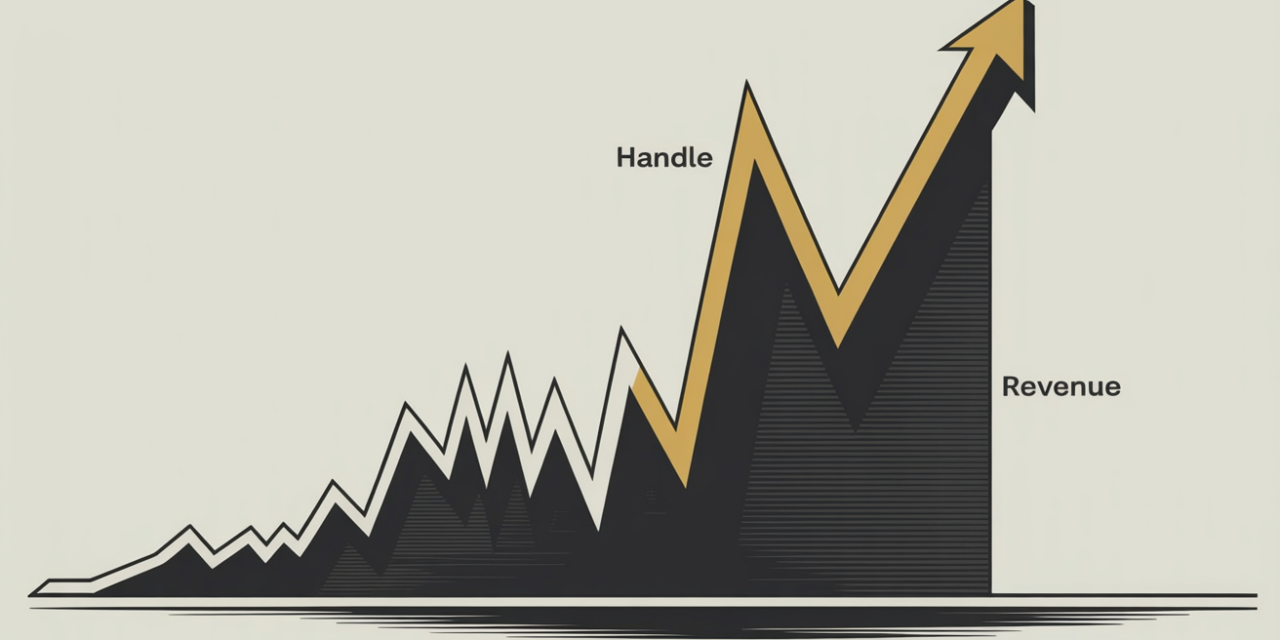
A company can grow handle at 3.4x and shrink sequentially on revenue at the same time. That is not a contradiction. It is a business model change.
Why growth slowed exactly when volume exploded
This is the part that matters, and it is a structural point rather than a trading wobble.
DFS is a principal business. Underdog takes entry fees, pays out winnings, keeps the difference and carries the risk. On 2025 numbers — $441m of net revenue across 3.2 million active customers, against monthly handle per active user of roughly $369 — the implied take on handle is somewhere around 3%.
An exchange is an agency business. Underdog charges a taker fee and a maker fee, carries no market risk, and books the commission. Typical event-contract fee levels are a small fraction of notional. The deck’s own chart shows the migration: prediction markets went from 14% of handle in 2025, to 54% in H1 2026, to a projected c.99% in the future state.
Put those together and the mechanics are unavoidable. If take rate falls from roughly 3% to roughly 1%, notional volume must approximately triple simply to hold revenue flat. Underdog’s volume growth is genuinely spectacular — baseball handle up 3.4x, tennis up 8.2x — and it is still only producing 11% revenue growth, because it is racing a denominator that is shrinking underneath it.
None of which makes the strategy wrong. Owning the brokerage, exchange and clearing house (FCM, DCM, DCO) captures economics at every layer rather than leaking them to Kalshi, and the addressable state count moves from around 40 for DFS to roughly 50 under the CFTC framework. But the honest description of the transition is lower yield, much larger pond, and a period in the middle where the two effects cancel out. IG’s deck does not describe it that way.
The earnout is a stretch, and the midpoint is anchoring
The $200m earnout requires 2026 net revenue between $533m and $600m, with positive EBITDA. Against H1 2026’s $250.1m, that means H2 2026 must deliver between $283m and $350m.
Measured against H2 2025’s derived $215.9m, that is growth of +31% at the threshold and +62% at the cap — after a first half that grew 11%.
The obvious defence is NFL seasonality. It does not hold up especially well: on the derived split, Underdog’s H2 2025 was below its H1 2025, despite prediction markets launching in September 2025. Whatever seasonal skew exists in the DFS book is evidently not large enough to rescue the arithmetic on its own. The step-up has to come from the exchange — which went live roughly two weeks before the merger agreement was signed.
There is also a definitional hazard worth flagging. An earnout denominated in “net revenue” is being measured across precisely the period in which the revenue definition migrates from gross gaming revenue net of bonusing to exchange commission. Reasonable people will read that clause differently in eighteen months. Reasonable lawyers will bill for it.
The management incentive plan is the real headline
Buried behind the $1.3bn number is an $850m maximum MIP, which IG describes as self-funded by Underdog’s earnings. Two footnotes on slide 15 explain what “self-funded” means in practice.
The thresholds
The maximum requires Underdog to deliver EBITDA of at least $400m in 2028 and $700m in 2029. For scale: Underdog lost $52.8m of EBITDA in 2025 and made $59.6m in H1 2026. IG Group itself generated £282m of EBITDA in H1 2026, implying a full-year figure in the region of £500m — roughly $650m. In other words, the top of the MIP requires Underdog, within three years, to out-earn the entirety of IG’s existing global business.
The payout curve
The 2029 schedule pays $1.45 of MIP per $1 of EBITDA between $278m and $416m; $0.54 per $1 between $416m and $600m; and $2.00 per $1 between $600m and $700m.
Read that last band again. In the top $100m of EBITDA, every incremental dollar delivered to shareholders triggers two dollars of payout. The band is plainly designed as a super-accelerator to make founders swing for the fences, and the total is capped — but as drafted, marginal value in that range accrues to management, not to IG’s owners.
Aggregate it: in the maximum scenario, management takes $850m out of the $1.1bn of combined 2028–29 EBITDA the plan is predicated on. IG shareholders retain roughly $250m, pre-tax, from two years of peak performance. “Self-funded” is doing a great deal of load-bearing work in that sentence.
The “DFS floor” argument contradicts IG’s own chart
The regulatory outlook slide makes a specific claim: that a proven, fast-growing $400m+ net revenue DFS business provides a revenue floor should the event-contract framework unravel.
Three slides earlier, the same deck projects DFS falling to around 1% of handle. Underdog cut more than 20% of its workforce in March 2026 as part of that pivot. It acquired, rather than built, its exchange and clearing infrastructure. You cannot simultaneously present a business unit as your downside protection and as the thing you are decommissioning. Pick one.
The steelman is that DFS licences, state relationships and government-affairs capability are the real floor rather than DFS revenue — optionality to re-enter if the federal route closes. That is a defensible argument. It is not the argument the slide makes, and it is worth a good deal less than $400m of run-rate revenue.
Root cause: IG bought growth because it does not have any
Strip away the convergence language and the strategic logic is simple. OTC derivatives account for 74% of IG’s revenue. IG holds under 10% of a market the deck sizes at over £8bn and growing at low single digits. That is a mature share of a slow pond, structurally compressed by a decade of European regulatory tightening.
The H1 2026 numbers make the point sharper: revenue up 18% to £642.8m, EBITDA up just 4% to £282m. Growth is being bought, not compounded. Freetrade, Independent Reserve, tastytrade and now Underdog are all answers to the same question.
Which reframes the transaction honestly: IG is exchanging European regulatory compression for American regulatory uncertainty. Different risk, same category. Both businesses depend on a carve-out surviving.
The product is regulatory arbitrage. That is both the return and the risk.
Sports event contracts are not a better mousetrap than a sportsbook. Functionally, a customer buying a Cowboys contract at 60c is doing what a customer taking -150 does. The difference is the regulatory perimeter: a CFTC-regulated venue reaches roughly 50 states under one federal regime, versus around 38 for licensed online sports betting, and does so without state gaming tax, without state-by-state licensing capex, and without state advertising restrictions.
That is a formidable cost advantage. It is also, by construction, unstable. Sixteen states are contesting the framework, with injunctive relief, disgorgement and civil penalties on the table. There are only three ways this resolves:
- States prevail. The sports vertical fragments back toward a state-licensed model and the addressable-state advantage evaporates.
- Federal formalisation. Congress or the CFTC codify sports event contracts — and, on all historical precedent, tax and regulate them closer to gambling.
- Prolonged ambiguity. The current state persists, which is the bull case, but is not a state a $2bn acquisition can safely underwrite for five years.
Two of the three outcomes compress the arbitrage. The bull case requires the least stable of the three to persist longest. That is the actual bet IG is making, and no amount of licence-stack diagramming changes it.
Governance: the chief executive who was already a shareholder
IG disclosed, in a footnote, that Breon Corcoran holds approximately 0.34% of Underdog’s fully diluted share capital via preferred shares and options acquired in March 2021 and January 2023 — before his appointment as IG chief executive in December 2023. He negotiated the transaction with the board’s knowledge and approval, then recused himself from the board’s formal approval.
Everything here appears properly handled: pre-dated holdings, disclosure at the outset, identical consideration to other holders of the same class, unanimous board support. It is also true that Corcoran ran Paddy Power Betfair when it acquired DRAFT, the company Underdog founder Jeremy Levine built before Underdog — which is presumably what the deck means by a relationship developed over many years.
The recusal covered approval, not negotiation. On a transaction of this size, with contingent consideration this large, some shareholders will consider that distinction worth raising at the 22 October strategy update. They would not be unreasonable.
Verdict: right thesis, generous plumbing
The strategic case is sound. Prediction markets are the most consequential structural development in US wagering since PASPA fell, sport is overwhelmingly the volume driver, and vertical integration across FCM, DCM and DCO is genuinely the differentiated position. IG had no realistic organic route in, and 2.4x revenue for the number three venue with a full licence stack is not an expensive entry ticket.
The argument is not with the thesis. It is with the plumbing: an earnout that needs a 31–62% second-half acceleration after an 11% first half; an incentive plan that could absorb three-quarters of the earnings it demands; a downside case that rests on a business unit being wound down; and a TAM slide whose most important number is an internal estimate applied to a third-party volume forecast.
The market closed the shares up 1%. That is not scepticism. That is a market waiting for 22 October to see whether IG will discuss the second half of the numbers as candidly as it has discussed the first.
Frequently asked questions
How much is IG Group paying for Underdog?
An enterprise value of approximately $1.1bn upfront, plus an earnout of up to roughly $200m, plus a management incentive plan worth up to $850m — a total potential commitment of about $2.15bn.
What does Underdog actually do?
Underdog began as a US daily fantasy sports operator and launched prediction markets in September 2025. It now owns a full CFTC licence stack — brokerage (FCM), exchange (DCM) and clearing house (DCO) — and is the third-largest US venue by regulated notional volume behind Kalshi and Robinhood.
What are the earnout conditions?
The 2026 earnout scales linearly across net revenue of $533m to $600m, capped at approximately $200m, and is conditional on Underdog remaining EBITDA-positive.
What is the main risk to the transaction?
Regulatory. Sports event contracts trade nationally under the CFTC framework but are contested by sixteen states, with injunctive relief, disgorgement and civil penalties among the potential remedies.
When does the deal close?
IG expects completion in late 2026 or early 2027, subject to regulatory and antitrust clearance. A strategy update is scheduled for 22 October 2026.