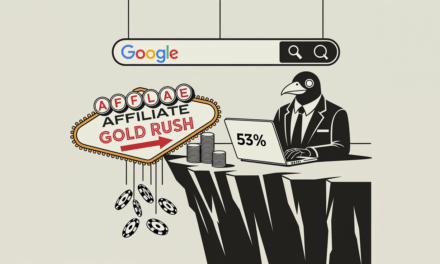

The affiliate business spent years mistaking bulk for a moat. Buy domains, flood Google with near-identical “best casino” pages, invoice bookmakers for depositors, then call the traffic pile a platform. In 2026, Catena Media’s recovery and Gambling.com Group’s retreat show that fiction is getting expensive.
The traffic-arbitrage bill has arrived
The old iGaming affiliate model was a spread trade disguised as publishing. Rank a commercially loaded page, send a user to a licensed operator, collect CPA or revenue-share payments, and repeat before Google rearranges the furniture. Acquisition multiples suggested a sophisticated media business; much of it was rental income from search.
That agreement is being repriced by the Google core update and zero-click search. Generic comparison pages, exact-match domains and interchangeable reviews worked when Google delivered reliable users and operators paid heavily for first-time depositors. Generative answers settle basic queries without a publisher visit. “Best online casino” still has value, but fewer clicks are predictable, visibility costs more to defend, and today’s rank can vanish on the next update.
This bites gambling affiliates harder than ordinary consumer publishers. Their claims sit beside licensing rules, bonus restrictions, withdrawal conditions and safer-gambling duties. A recycled review copied from operator marketing was never journalism; it was sales collateral with a tracking link. When search demands evidence, usefulness and authority, that material offers little beyond word count. The valuation logic collapses with it: unpaid search traffic can look magnificent until rankings, qualifying-deposit rules or regulators turn.
Catena’s recovery is subtraction, not resurrection
Catena Media reported €12.3 million in first-quarter revenue from continuing operations, up 26% year on year, and a Q1 return to profit. Meaningful, yes, after years when the company resembled an acquisition hangover with a ticker. But this is not a vindication of the old roll-up script. Disposals, lower overhead and a narrower focus are survival work, even if earnings decks give the surgery nicer fonts.
The remaining pitch—higher-intent sports audiences, CRM and sub-affiliate technology—matters because it shifts value from anonymous clicks. Sports users can be segmented by jurisdiction, preference and conversion likelihood. CRM creates a route back to consented users instead of paying Google’s toll on every visit. The split is paid media arbitrage versus lean CRM. Sub-affiliate tools can earn from partner distribution and workflow, not merely Catena sites outranking rivals.
None of this is immunity. Sports betting is seasonal; operators can cut CPA rates, tighten qualification rules or move spend direct. Regulators can erase a market overnight. Still, a smaller profitable company can invest where conversion data earns it, reject vanity acquisitions and negotiate without a liquidity crisis at the table. Catena is trying to own data, repeat contact and partner infrastructure. The old SEO affiliate owns a temporary place in somebody else’s results.
Gambling.com’s AI story cannot repair commodity economics
Gambling.com Group’s sequence is uglier. Its stock crashed 50% after a Q1 net loss, then came 25% layoffs marketed as an AI-led overhaul. Investors were not rejecting technology; they were asking whether the cost base, acquisition assumptions and traffic economics still add up.
AI can cut repetitive production, update data and flag stale promotions. It can help compliance teams and editors. It cannot create trust, proprietary audience or an attractive referral margin. Worse, automation makes volume inventory easier for every rival to copy. If the product is localized comparison pages and keyword variants, supply rises while differentiated demand does not. Google controls discovery, operators control payouts, and the affiliate gets squeezed between them.
Costly media acquisitions make the trap worse. Buying an audience works only if it stays monetisable, cross-selling is real and integration produces savings rather than PowerPoint optimism. Layoffs may preserve cash, but they can also remove people who understand local rules, challenge dubious offers and maintain sportsbook relationships. Then weaker controls breed partner disputes, compliance failures and search-quality problems. The spreadsheet calls it efficiency until revenue objects.
Operators inherit the risk they thought they outsourced
Bookmakers inherit this risk. As qualified traffic tightens, serious publishers seek better terms and operators demand evidence of player quality, retention and jurisdictional compliance. Hybrid deals, longer qualification windows and tighter audit rights are self-defence. Publishers with consented first-party data, newsletters, apps, event communities or specialist local audiences gain bargaining power. Smaller operators may lose access as premium publishers select bigger budgets and cleaner compliance records.
Stress also produces bad behaviour. Squeezed affiliates can shout bonuses, bury restrictions, push offshore links and chase users through aggressive retargeting. Licensed operators cannot pretend the affiliate is unrelated: in the UK, Ontario and regulated US states, misleading partner promotion can become the operator’s fine and reputational damage. Search engines may remove low-value pages, yet zero-click answers concentrate discovery inside the platform. Fewer independent comparisons can mean less scrutiny of wagering requirements, withdrawal limits and safer-gambling terms.
The next two years reward owned demand
Through 2027 and into 2028, the sector will be smaller, more technical and less forgiving of borrowed attention. Winners will show where users came from, why they return, what consent exists and why an operator should pay after Google, regulators and automation take their slices.
Catena’s Q1 does not certify health; one profitable quarter cannot erase years of damage. It does prove that accepting reality—sell, cut, focus, rebuild direct capability—can restore room to operate. Gambling.com offers the harder lesson: AI is a cost tool, not a resurrection ritual. If automated text was the product, automated text is also the commodity that destroys its price.
The gold rush is over. What remains is a fight over owned relationships, compliant distribution and margins that survive the balance sheet. Anyone calling generic SEO volume a growth strategy is waiting for the invoice.