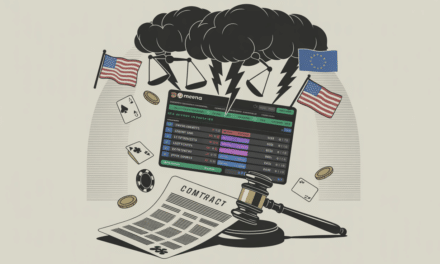
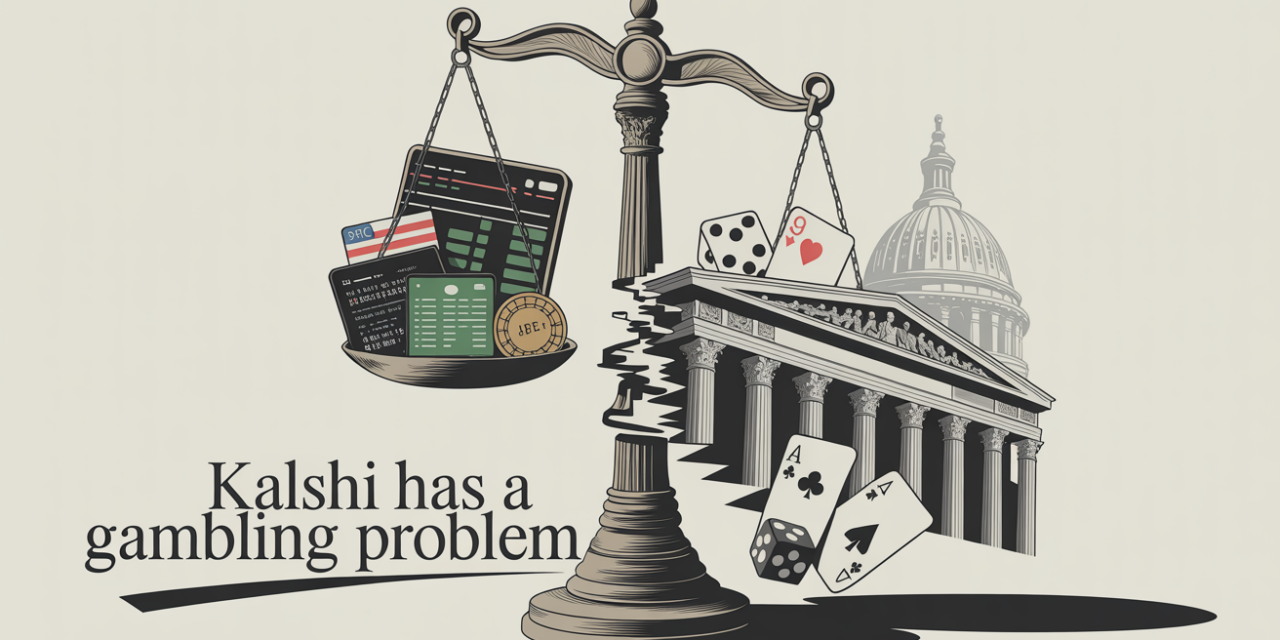
In the annals of American gambling law, last Friday’s Ninth Circuit ruling in Kalshi v. Nevada will be remembered as the moment the prediction market industry’s grand federal preemption strategy collapsed — not with a whimper, but with a judicial panel willing to deploy sarcasm as jurisprudential punctuation. “Kalshi has a gambling problem,” wrote the three-judge panel, in a line that will appear in law school casebooks for the next three decades. The question is no longer whether states can regulate prediction market sports contracts. They can. The question is what happens next — and the answer could fundamentally restructure not just prediction markets, but the entire American gambling ecosystem.
Why the Preemption Argument Was Always a Legal Long Shot
Kalshi’s legal thesis was elegant in its audacity: because the CFTC — a federal agency — had approved event contracts on sports outcomes, the Commodity Exchange Act preempted any conflicting state gambling laws. Federal law trumps state law. Simple. Clean. Wrong.
The flaw was that the CEA contains an explicit savings clause preserving state authority over gaming — a carve-out written in precisely because Congress, when it expanded CFTC jurisdiction in 2010, had no intention of inadvertently federalizing American gambling law. Nevada’s lawyers understood this. They argued, correctly, that a federal agency cannot by administrative approval override a Congressional carve-out. The Ninth Circuit agreed, unanimously.
The deeper problem is structural: Kalshi was trying to resolve a political question — what should American gambling policy look like? — through an administrative law mechanism. Courts are notoriously reluctant to let agencies do via rulemaking what Congress has deliberately declined to do via legislation. The PASPA repeal in 2018 delegated sports betting back to states explicitly. You can’t un-delegate that by getting the CFTC to approve a swap contract.
The SCOTUS Trajectory: A High-Stakes Game With No Guaranteed Outcome
Kalshi will almost certainly seek certiorari. The company has publicly framed this as an existential regulatory question, and their investor base — which includes some of the sharpest minds in Silicon Valley and crypto — has the capital and the appetite to fund a Supreme Court campaign. But SCOTUS takes fewer than 80 cases per year. And there are three reasons it might decline to hear this one.
First, there is not yet a clean circuit split. Novig is litigating in Massachusetts and New Mexico, and the Second Circuit — where Connecticut’s case could eventually land — hasn’t ruled. SCOTUS generally wants to see conflicting circuit outcomes before wading into an area. Second, the political environment is volatile: if Congress passes a federal prediction markets framework (several bills have been introduced in 2026), the question becomes moot before the Court can rule. Third, the current Court’s textualist majority might actually agree with the Ninth Circuit’s reading of the CEA savings clause — which would produce a loss for prediction markets at the highest level, far worse than a circuit court defeat.
The wild card, of course, is political: Donald Trump Jr. and elements of the White House have inserted themselves into this debate. A Republican-controlled Congress that wants to be seen as pro-innovation and anti-regulatory-overreach might find legislative action more palatable than letting the courts fumble it.
The Three Scenarios Operators Need to Model Right Now
Scenario A — SCOTUS grants cert and sides with states (prob. ~30%): Prediction market sports contracts are definitively classified as gambling at the federal level. CFTC loses jurisdiction. Platforms either exit sports markets, pivot to elections/economics, or die. Traditional sportsbooks exhale. Polymarket pivots harder into non-US markets. Regulatory arbitrage intensifies globally.
Scenario B — Congress legislates (prob. ~40%): A federal framework carves out prediction markets from state gambling law explicitly, subject to CFTC oversight and federal responsible gaming standards. This is the most economically rational outcome and probably where Republican-aligned lobbying is pushing hardest. Sportsbooks lobby furiously for tax parity and product restrictions. A messy compromise that satisfies nobody perfectly but creates legal certainty.
Scenario C — Multi-year legal stalemate (prob. ~30%): State enforcement actions proliferate, but Kalshi and peers continue operating while litigation winds through courts. The map fragments into state-by-state permission zones, similar to cannabis pre-federal. Operators with the capital to sustain compliance costs survive; smaller platforms fold. Consolidation accelerates. DraftKings or FanDuel acquires a prediction market platform as a hedging strategy.
The Real Stakes: $100B+ and the Future of Price Discovery in American Sports
Strip away the legal theatrics and what you have is a fight over an enormous addressable market that genuinely doesn’t fit neatly into existing regulatory categories. Prediction markets are neither purely financial instruments nor purely gambling products — they’re something new, and American law is struggling to catch up with that novelty.
The economic functions are real: the LeBron market data (11x returns in 303 milliseconds on news events, as Gambling Insider documented this week) demonstrates that these platforms are becoming genuine price discovery mechanisms for real-world events. The question is whether that economic utility justifies routing around 50 state-level regulatory frameworks built over decades to protect consumers.
The Ninth Circuit’s answer is: not yet. Not without Congressional authorization. And that is, frankly, the correct legal answer — whatever one thinks of the policy question. Kalshi rolled the dice on an administrative law theory that was always legally fragile and commercially opportunistic. The bill is now due. The next move belongs to Congress, to SCOTUS, or — most likely — to both simultaneously, in a chaotic parallel process that will define American gambling regulation for a generation.
The Ninth Circuit’s Kalshi ruling doesn’t kill prediction markets — it kills their cheapest regulatory strategy. The industry now faces a costly, multi-year battle across courts, state capitals, and Congress. Well-capitalized platforms with diversified market exposure (elections, economics, crypto events) will survive. Pure sports play pure-plays are the most exposed. Watch the Congressional calendar: a federal framework bill before 2027 is the most likely path to resolution, and the lobbying arms race is already underway.