Fanatics has put a $1 billion price tag on its next US sportsbook customer grab, giving rivals a choice: defend their share of voice or watch attention drift. Michael Rubin’s proposed 2027 ad budget signals that acquisition costs are rising as prediction markets compete for the same attention, deposits and time. The spend is a warning, not a victory; the test is whether customers stay long enough to pay for themselves.
A billion-dollar bid changes the price of attention
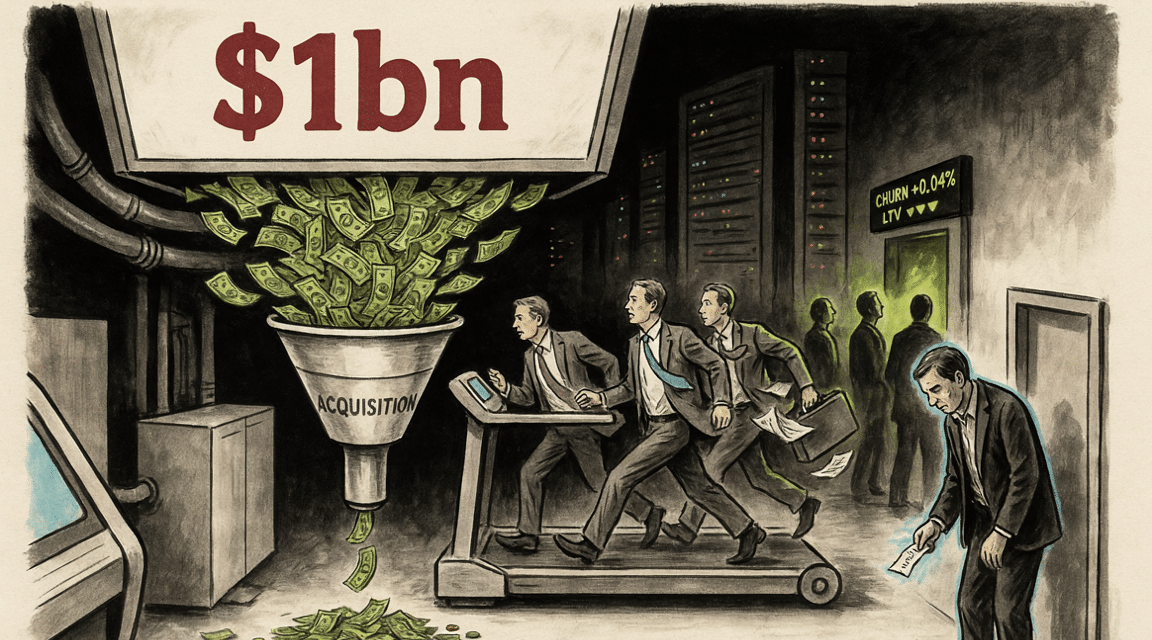
Michael Rubin told Bloomberg that Fanatics could spend up to $1 billion advertising its betting business in 2027, compared with roughly $350 million expected in 2026. That jump changes the terms of the fight: rivals must defend their share of voice or accept that a bettor weighing another app may choose Fanatics. Either way, more money chases the same customer. The proposed budget raises the expected price of competing before a dollar is spent.
Fanatics has made real progress since launching its sportsbook in 2023. It has captured more than 10% of the US betting market in about three years and is live in more than 20 states. DraftKings and FanDuel still lead, after years of promotion, product development and customer retention. A larger advertising budget can accelerate Fanatics’ push, but it cannot buy a durable position on its own.
The key measure is customer acquisition cost, or CAC. Announcing marketing spend is easy; earning it back through a customer’s long-term value is harder. A sportsbook can generate downloads and still destroy value if bonuses, media costs and other incentives take too long to recover. Dimers’ traffic data suggests Fanatics has room to grow: over the past 12 months, its pages generated almost as much traffic as DraftKings pages and comfortably exceeded FanDuel’s. Web traffic is not handle, revenue or retention. It shows attention is closer than market position suggests, but visits must become accounts and repeat play or they remain an expensive vanity metric.
Cash gives Fanatics runway, not a blank cheque
Fanatics has the financial room to make its threat credible. The company projects roughly $14 billion in total revenue, with about $2 billion from betting. It is privately held, carries no debt and is expected to generate around $2 billion in free cash flow. That gives Rubin more room to fund a long acquisition campaign without having to defend every quarter’s payback to public-market investors. Private ownership can allow a longer route to returns, but it does not change the economics of customer value. If Fanatics spends aggressively and fails to retain customers, weaker cash generation leaves less capacity for future investment. If it creates durable engagement, DraftKings and FanDuel will have to pay more to protect their positions. The outcome turns on retention, not the length of the runway.
Rubin’s account of the changed contest is blunt: “FanDuel and DraftKings competed with themselves two years ago. Now they have Fanatics, Kalshi and Polymarket. All the marketing costs are up.” Sportsbooks are no longer bidding only against one another for sports fans. Other products want the same attention, deposits and time, making campaigns less efficient even before a rival takes a customer outright.
Prediction markets pinch the sportsbook funnel
Kalshi and Polymarket complicate acquisition economics by drawing users around events sportsbooks also want to own. The threat starts upstream: a prospective customer may build a habit or place a trade in a prediction market before a sportsbook acquires them. The person may still care about sport, but another product now stands between an advert and a deposit. More competing products can mean higher acquisition costs and weaker conversion.
Fanatics has also moved into prediction markets by acquiring relevant technology. That is both defence and expansion: it gives the company a way to meet customers in a category drawing attention away from traditional betting, and could let one marketing push support a broader product offer. But a wider menu improves acquisition economics only if customers use those products and remain valuable. More choice is no substitute for evidence of retention.
DraftKings’ numbers show why investors see the category as both a threat and a possible source of revenue. Bank of America upgraded the stock to buy with a $27 price target after a 47% decline over the past year and its lowest close since April 2023. Analyst Julie Hoover estimates prediction markets could add roughly $400 million in fees and $200 million to $400 million in market making next year. Those are estimates, not booked results. They show how a product that competes with sportsbooks for customers might also generate income for an operator entering the category.
The operating forecasts remain mixed. DraftKings’ 2026 EBITDA estimate was cut by about 20% to $500 million, while its 2027 estimate was raised to $1.15 billion from $1.05 billion. That is no clean endorsement of prediction-market economics: near-term costs and longer-term expectations are moving in different directions. If new income materialises, it could soften pressure on DraftKings. Until then, prediction markets remain another claimant on the customer relationship, not a proven fix for sportsbook acquisition costs.
The scorecard is customer payback
Fanatics has put a credible number on its ambition, but spend alone says little about competitive strength. The evidence will be whether its campaign attracts customers who stay active and generate enough value to cover the cost of winning them. DraftKings and FanDuel have scale; Fanatics has financial flexibility and growing reach. None of those advantages settles the CAC equation.
The industry is also chasing scale through deals. Casino merger and acquisition interest remains vibrant despite high borrowing costs, suggesting operators see size as a defence against expensive competition. Debt-funded consolidation and a cash-rich advertising push solve different problems: one combines assets, the other bids for attention. Either can inflate growth expectations before improving returns. If acquisition costs keep climbing, operators must show that scale produces more than a larger bill.
In 2027, the scoreboard will not be the number of adverts or the volume of a launch. It will be market share gained, retention maintained and acquisition costs recovered. If Fanatics makes the $1 billion work, the duopoly becomes a three-way fight and everyone faces a more expensive defence. If it fails, the spend will expose the gap between buying attention and earning repeat business. Campaigns will generate headlines; payback will decide who still has room to spend after them.