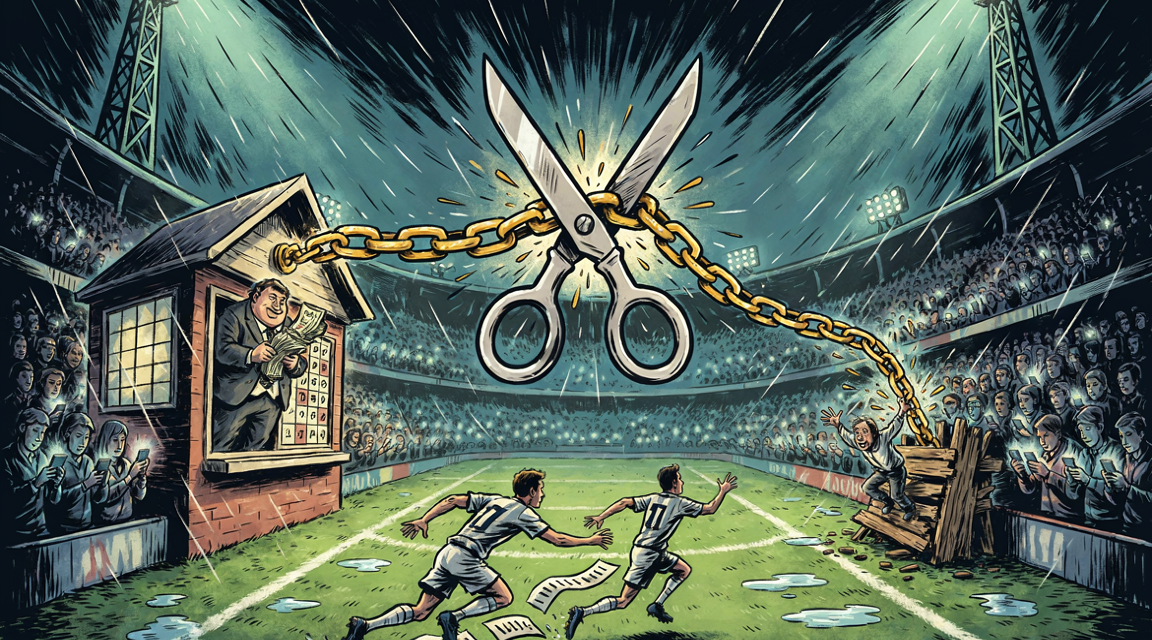
Denmark’s revived whistle-to-whistle betting ad ban is aimed at more than what viewers see during a match. Its sharper intervention reaches the commission cheque: affiliates could no longer be paid according to referred players’ turnover or losses, putting customer-acquisition economics under pressure.
The bill returns with a long runway and a defined blackout
Minister for Taxation and Growth Jakob Engel-Schmidt presented the bill on 7 October 2026. It re-submits L 127, which lapsed when the parliamentary session ended on 24 March 2026, and is slated for a first reading on 22 October. The government targets entry into force for 1 January 2027, with provisions phased in through the year; marketing restrictions, including the live-sport ban, are due in July 2027.
The timetable revives a proposal first put in view when Denmark announced Spilpakke 1 in October 2025. The revived bill gives the package another route through parliament and a rule designed to remove gambling promotion from the moments when audiences are most concentrated. Operators and publishers have transition time, but the dates offer no lasting escape from a changed commercial model.
The advertising blackout would run from 10 minutes before kick-off until 10 minutes after a live sports broadcast. It would also cover live odds displayed on stadium screens and streaming platforms. A television-only rule could push the same message to a venue screen or another device; Denmark’s proposal tries to close those substitution routes by targeting the live event wherever viewers encounter it.
The affiliate clause is the commercial sting
That visible ban may dominate the headline, but the commercial sting is the rule against affiliate payments calculated from players’ turnover or losses. The bill would not outlaw every affiliate relationship. It would rule out revenue share tied to the continuing gambling activity of referred customers, a model that can pay a publisher long after an initial referral.
Revenue share can provide recurring income to fund content, search visibility and acquisition campaigns. Remove the link to turnover or losses and operators and affiliates must revisit how they price, contract and measure performance. Fixed-fee or acquisition-based payments may become more attractive where permitted, yet a new label alone will not prove a deal complies with the bill’s wider controls.
The squeeze will be uneven. Large operators may have more room to redesign acquisition plans around different commercial terms. Smaller affiliates reliant on recurring commission may find the change harder to absorb. If fewer publishers can afford to produce or distribute gambling content, licensed operators lose an established route to customers. If affiliates continue under alternative payment models, both parties need a clear answer on what the regulator considers compliant. Uncertainty can cost money before any final ruling: businesses may cut activity while they wait to see where the line sits.
Other affiliate terms face controls too. Free games in welcome bonuses would be banned, prize draws above DKK 1,000 prohibited, and the regulator would gain power to block affiliate sites. Affiliates and influencers would also become liable under the marketing rules. Publishers therefore stop being distant suppliers and become part of the regulated marketing chain, exposed when a promotion breaks the rules.
Consumer protection brings operational duties and penalties
Marketing controls are part of a broader package. Ads could not feature anyone under 25, target under-18s, appear within 200 metres of schools or youth institutions, or run on public transport. Operators would also acquire a legal duty of care: monitor player behaviour, intervene when needed, keep records and train staff. Players would face a loss limit, with a 48-hour delay before they could raise it.
The duty changes the compliance question from what an advertisement says to what an operator did when behaviour raised concern. Monitoring, intervention and record-keeping require auditable processes, not a policy statement kept for inspection. The delay also makes an immediate reversal of a safer choice harder. Operators will need to explain how limits work and apply them consistently, or a protective measure could turn into a dispute when a customer wants to change one.
Penalties are designed to give the rules force. Land-based venues could face fines of DKK 60,000 to DKK 80,000, with a third violation likely to trigger licence suspension. Online fines would be scaled to a proportion of gross gaming revenue. Providing unauthorised gambling could bring fines or, in aggravated cases, up to one year in prison. A breach therefore risks more than the cost of one campaign; repeated failures could threaten an operator’s right to operate.
The government expects to lose DKK 15 million in tax in 2027 and DKK 25 million a year thereafter. The regulator could lose DKK 1 million to DKK 2 million in fees. Those projections put a price on the policy choice: the state accepts lower tax and fee income in exchange for tighter controls. Critics warn that restrictions could push customers towards the black market and deepen the tax decline. That result is not certain, but it is a real risk if licensed brands become harder to find while demand persists.
Europe will watch the affiliate precedent
Denmark is moving in the broad direction of the UK, France, the Netherlands and Sweden, all tightening gambling marketing rules. The whistle-to-whistle restriction targets the moment of exposure; the affiliate clause reaches the less visible financial incentive behind promotion. That makes the payment rule especially useful for other governments studying how marketing works in practice.
They need not copy every Danish restriction to borrow the underlying logic: constrain placement, restrict incentives and make intermediaries answerable for promotion. If the bill passes and proves enforceable, Denmark could offer a practical precedent for treating revenue-share payments as a marketing-control issue, rather than merely a private contract between operator and publisher.
The test is whether the policy can reduce exposure without making licensed brands harder to find than unlicensed alternatives. Blocking affiliate sites and tightening commissions could close routes used by compliant operators, but neither step alone removes demand or guarantees illegal sites disappear. The first reading on 22 October is the next milestone. The decisive questions come later: what survives in the final wording, how the July 2027 restrictions are implemented, and whether the regulator applies them consistently.
Denmark is targeting both the visible advertisement and the money that motivates its distribution. If the approach holds, the next European debate will concern not only where gambling can be promoted, but also how promoters are paid.