Entain’s Q3 delivered the kind of growth headline executives like and investors distrust: UK & Ireland online revenue climbed 14%, while Brazil fell 36% after an abrupt policy shock. Group NGR still grew, but one government decision stripped roughly four percentage points from growth. The quarter shows how quickly hard-won demand can be wiped out—and why the same company can look healthy in one market and badly exposed in another.
UK demand is real; group growth is less clean
Entain reported Q3 group NGR growth of 2% at constant currency on 15 October, with online NGR up 3%. That is growth, technically. It is also a thin headline over a split performance: Gaming grew 8%, while Sports fell 3% as customer-friendly results squeezed sports margins. Entain put the margin headwind at roughly 1–2 percentage points, implying about a four-point drag on online growth. The distinction matters: the margin drag can depress reported growth without showing that customers have lost interest, but it still leaves earnings exposed to results operators cannot control.
UK & Ireland is the clearest proof of underlying demand. Regional NGR rose 8%, with online up 14%: Gaming gained 17% and Sports 3%. Volumes increased 15%, while UK retail like-for-like NGR grew 3%. The mix matters: this growth was supported by more activity, not only a favourable shift between products. It does not establish that each extra unit of activity carries the same margin, and the customer-friendly sports results are a reminder that volume alone cannot settle the earnings question. Still, beside modest retail growth, the digital result shows where Entain’s strongest reported demand sits.
The contrast with the rest of the business matters. Excluding Brazil, Q3 online NGR grew 5%; year-to-date online growth was 8%, ahead of the previous 5–7% guidance range. New Zealand, Spain and Canada also delivered double-digit online growth. There is a functioning growth engine here, with UK & Ireland in front and several markets adding support. It simply does not operate at the same speed everywhere, or under the same rules.
Brazil turns policy into operating risk
Brazil NGR plunged 36% after an immediate online gambling ban was announced on 25 September. International NGR fell 4%, with Online down 3% and Retail down 12%. The Brazil hit stripped roughly four percentage points from group growth, according to the quarter’s stated impact. That is the brutal arithmetic of geographic exposure: one policy decision can consume a large share of growth earned across multiple markets. It turns country exposure from a portfolio footnote into a direct question about whether strong local demand can become group-level growth.
Operators invest in customer acquisition, technology and compliance on the assumption that they can keep serving a market under its rules. When access is abruptly shut off, those costs do not politely vanish with revenue. The immediate hit appears in NGR; the longer-term damage is uncertainty over where capital can be deployed safely and what regulatory permission is worth. That uncertainty can make a market harder to justify, while leaving the operator to absorb investments already made.
Entain’s ex-Brazil numbers make the comparison stark. Online growth would have been 5% in the quarter without the country’s collapse, rather than the reported 3%. That counterfactual helps investors separate demand weakness from regulatory destruction, because the remedies differ. Better product execution can address the first. The second requires political access, legal certainty and a willingness to accept that a market may disappear before an investment has paid back. Investors have to price both risks; a product fix will not repair a government ban.
UK tax could damage the engine it feeds
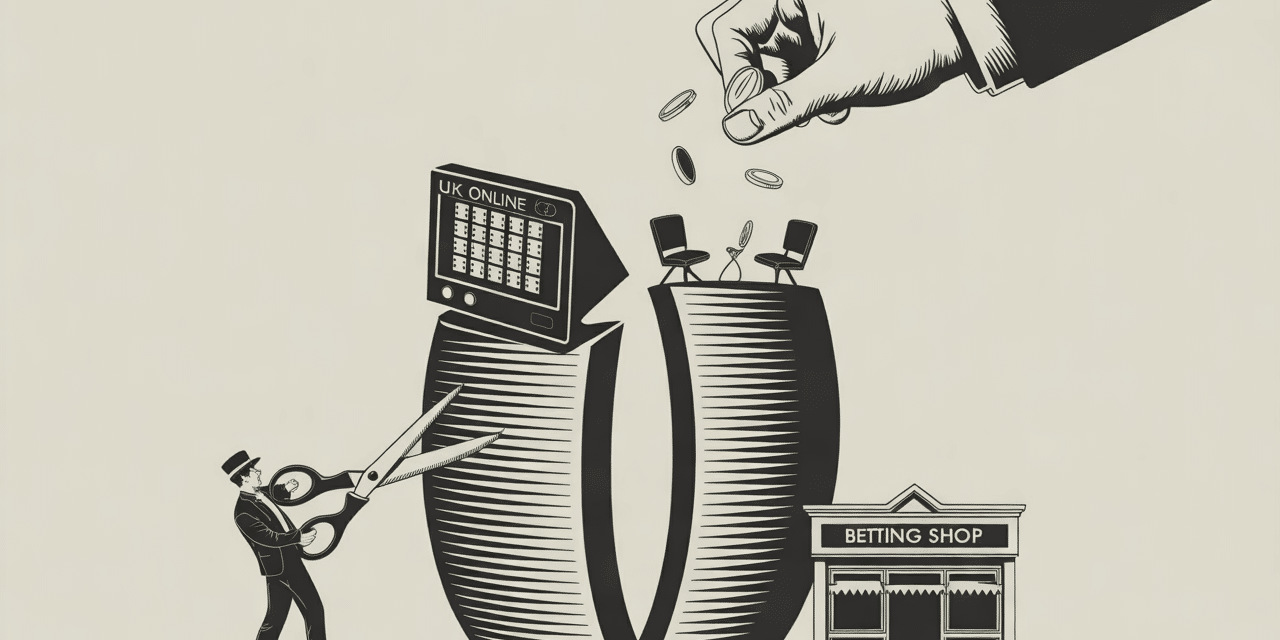
Stella David, Entain’s CEO, flagged the risk of potential UK gambling tax increases and warned that they could close betting shops and cost jobs. The warning lands awkwardly beside UK online growth of 14%, but the facts do not contradict each other. A tax change can hit products and cost bases differently; shops carry physical operating costs that an online business does not. If the burden rises, operators may cut costs, reduce investment or shrink retail estates. Staff and local communities would feel that adjustment before it appeared in an investor presentation.
That makes the UK government’s choices unusually consequential for Entain. The company’s strongest reported growth is coming from a regulated market, the sort policymakers may treat as a dependable tax source. But regulation that extracts too much can weaken the legal business it is meant to tax, shifting activity away from licensed operators or forcing legitimate firms to retreat. A smaller regulated footprint could mean less activity left to tax and fewer jobs in the retail network. David’s warning is an interested party’s argument, not neutral evidence; the underlying trade-off is real. Higher receipts today can mean a smaller regulated business tomorrow.
The share price fell about 2.34% on the update. Entain reiterated FY26 online NGR guidance of 4–6%, with growth excluding Brazil expected at the top end of 5–7%. Underlying EBITDA, excluding parent fees, is still expected at the lower end of the £910m–£960m range. Investors are weighing resilient UK demand against the lower-end earnings outlook and the possibility that the UK becomes a policy headwind of its own.
BetMGM helps, but it is no policy hedge
BetMGM, Entain’s 50/50 joint venture with MGM, reported Q3 net revenue of $710 million, up 7%, and adjusted EBITDA of $86 million, up 112%. iGaming net revenue increased 6% to $483 million. Those figures show another source of growth and improving profitability in the wider Entain relationship. They do not erase the Brazil problem or turn an uneven quarter into a clean win. The joint venture is a separate contributor, not insurance against a government changing the rules.
Entain is also proceeding with a phased exit from Entain CEE, beginning with the divestment of an initial 20% stake. The portfolio change, Brazil shock and UK tax debate point to the same investor question: where can the company grow without having its economics reset by policy or exposure? For now, the clearest answer is UK & Ireland online, supported by several other markets and BetMGM. The next results will show whether that growth can carry the group while regulators decide how much of it they are willing to leave standing.