
On 3 November 2026, Nebraska voters rejected online sports betting despite a petition campaign that raised nearly $22.5 million, the most expensive in the state’s history. The result is more than a costly setback for DraftKings and FanDuel: it shows that campaign money cannot manufacture local consent, and that the next phase of US iGaming growth will be fought in legislatures, regulatory offices and the gaps between state and federal authority.
The campaign could not buy consent
Initiative 440, the constitutional amendment authorising online wagering through racetrack-linked operators, failed 324,828 to 396,050: 45.1% supported it and 54.9% opposed it. Initiative 441, the statute setting out the operating framework, failed 327,844 to 392,980. Both measures had to pass; neither did. That paired defeat leaves no basis for saying voters accepted online wagering but objected only to its details.
The plan was not vague. It proposed a 20% tax on gross gaming revenue, with 70% directed to property-tax relief, two online skins per racetrack casino and a statewide cap of 12. Servers would sit in Nebraska, under the Nebraska Racing and Gaming Commission. Tax Relief Nebraska promised $166 million in property-tax relief. The terms answered practical questions about revenue, control and oversight. They did not settle the more fundamental one: did voters want online betting at all?
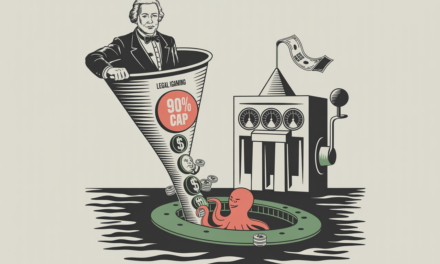
The campaign raised nearly $22.5 million through 29 October, after raising $14.65 million earlier that month. DK Crown Holdings and FanDuel each contributed $10.4 million, about 92% of the total; BetMGM and Fanatics contributed too. Save Nebraska Sports was outspent roughly 20 to 1, prompting State Treasurer Joey Spellerberg to call it a “David and Goliath” fight. Support clustered in Omaha; central Nebraska opposed the measures heavily.
That mismatch did not overcome the split. The tax-relief promise was designed to turn a contested product into a public benefit, but it did not bridge the credibility gap. Backers could choose a tax rate and earmark most of it; they could not make enough voters trust the forecast to accept the expansion behind it. In Nebraska, the offer did not change the calculation for a majority. That is a credibility problem, not a copywriting problem.
The ballot-box model is losing value
The result also changes the economics of campaigning. A record fundraising total still failed to win a majority, making the ballot a poor acquisition channel for an industry looking to repeat the play. This is not a literal price per vote: fundraising is not the same as spending, and every state differs. But the signal is plain. Operators can spend heavily, come close and still lose. Repeating the model across the remaining non-legal states would multiply the cost without guaranteeing a single new market.
Nebraska makes that risk durable. The state constitution bars the same measure from returning by initiative more than once in three years, so another petition cannot return before 2028. A legislature-referred question could arrive sooner, but lawmakers declined to act on online betting in both 2024 and 2025. That leaves operators without a near-term ballot route and without evidence that the legislature is ready to take up the issue.
Nor is Nebraska an isolated reminder that a commercial case is not a public mandate. Sports betting remains legal in person at the state’s five racetrack casinos, under a model authorised in 2020. On the same election night, Allen, DeKalb and Steuben counties in Indiana rejected a casino; Virginia voters rejected satellite pari-mutuel wagering at Churchill Downs facilities. These were different proposals in different political settings. Together, they warn against treating a well-funded campaign as consent.
Flutter CEO Dan Taylor acknowledged the result on the company’s Q3 call: “Obviously we were disappointed with the result in Nebraska where the ballot didn’t go in our favor, but I think we’ll take something from that,” while also pointing to a “strong pipeline of further state openings”. That pipeline may exist. Nebraska’s lesson is that a state-by-state plan built on voter initiatives carries a cost operators cannot control: voters can reject the product after the campaign has spent its money.
Regulators now set the terms
The contrast is clear in markets where expansion is decided through legislation and provincial regulation rather than statewide campaigns. Alberta reported C$122 million in iGaming revenue in its opening quarter. PENN says Alberta is tracking Ontario’s share, while operators have made different entry choices: PokerStars and 888 offer poker there, and GGPoker declined to launch.
That divergence is instructive. In regulated markets, the argument shifts from persuading an entire electorate to meeting a defined set of licensing, tax and compliance rules. Those terms can still make the economics unattractive, and approval is not guaranteed. But the process is legible: the regulator sets the terms, and each company decides whether the market works. Canadian provinces are weighing further regulated iGaming expansion, giving provincial policy more weight in operators’ growth plans than another expensive petition drive.
Policy can change at the federal level too. Canada’s advertising bill S-211 cleared the House of Commons heritage committee with a longer deadline, looser consultation duties and no ban on in-game advertising. That is a framework, not a prohibition. For operators, the question is whether rules will be written by institutions able to change them without asking voters to approve the product at the polls. The regulatory process itself is part of the commercial calculation.
Federal lines complicate the next bet
Prediction markets make the state-federal boundary harder to ignore. Nebraska voters rejected online sportsbooks, while residents can still trade sports event contracts through prediction markets operating under CFTC oversight. The result is an awkward asymmetry: voters rejected a locally licensed online betting model, yet sports-linked trading remains available through a different regulatory channel.
The vote does not decide whether prediction markets should be treated as gambling, financial products or something regulators have yet to classify consistently. It does sharpen the jurisdictional question. If state voters say no to sports betting while federally overseen contracts remain available, statehouses inherit a policy problem a ballot campaign cannot resolve. The state-federal boundary is already shaping what people can access, even as regulators contest where those products belong.
The next expansion cycle will test whether operators can build legislative coalitions, meet provincial rules and clarify the reach of federal oversight more effectively than they can persuade voters with a campaign cheque. Nebraska’s initiative route is closed until after 2028; the prediction-market opening may draw scrutiny precisely because voters did not authorise the competing model. Watch whether lawmakers act before that lockout ends, and whether federal oversight narrows or preserves the gap. Those decisions, not the size of the next ad buy, will determine what the industry can price into its growth plans.