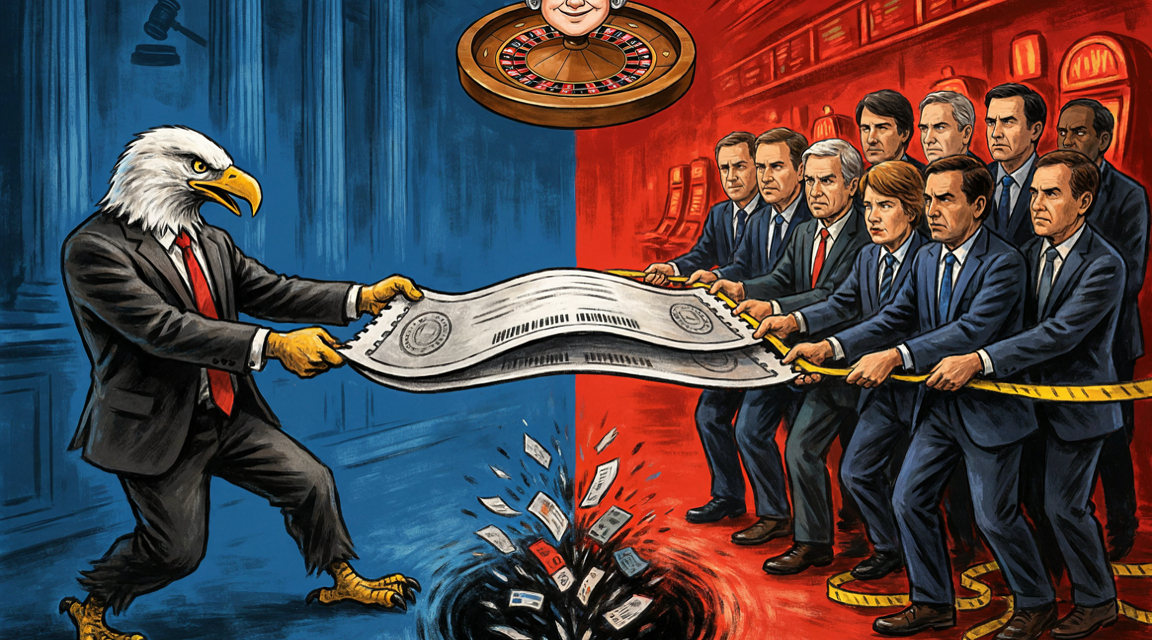
Prediction markets have crossed the swaps line, and Washington is deciding whether that line belongs to the CFTC or state gambling regulators. The answer will determine whether event contracts become a federally distributed financial product or a licensed wagering product subject to 50-state rules. The winner gets control of market access, customer data and a new rail running alongside sportsbooks and exchanges.
On 28 September 2026, the CFTC sent two prediction-market rules to White House OIRA. Proposed rule RIN 3038-AF82 would define “swap” to include event contracts. Interim final rule RIN 3038-AF81 would exclude “casino-style gambling products” from that definition. The second rule is designed to take effect on publication, bypassing notice-and-comment. CFTC Chairman Michael Selig says the agency has exclusive federal jurisdiction over these products.
The swap label is the whole fight
Event contracts borrow exchange mechanics: order books, price discovery, continuous trading and the ability to exit before settlement. Their economic effect can still look like a wager. That collision drives the dispute. Washington is deciding whether a product’s legal identity follows its trading machinery or the behaviour it encourages.
Under the CFTC’s theory, contracts on sports, elections and world events can sit inside the federal derivatives regime, while casino-style products remain gambling. That distinction gives the agency a route around state licensing. If an event contract is a swap, the CFTC becomes the primary regulator and a platform can argue that state gambling commissions cannot dictate where or how it operates.
RIN 3038-AF81 is the aggressive move. Taking effect on publication without the usual notice-and-comment process could deliver immediate commercial clarity, but it also hands challengers a procedural target. The agency is effectively arguing that gambling is a narrow product category and that anything with market structure belongs in federal finance. Clever? Yes. Secure? Hardly. State regulators and consumer advocates are attacking that exact premise.
The stakes are commercial. A federal classification can let an operator build once, distribute nationally and collect customer data across state borders. A gambling classification forces the same operator to buy licences, geofence users and meet a patchwork of local obligations. The label determines the cost of entry before a single contract trades.
States are fighting for distribution
At least nine states, including Ohio, Tennessee and New Jersey, are involved in litigation with prediction-market operators. The CFTC has countersued. The Sixth Circuit has ruled that Kalshi sports bets are not swaps, undercutting any suggestion that the federal answer is settled. Supreme Court attention is growing because the question reaches beyond one operator: it tests federal pre-emption across an entire category of products.
New York has sued Polymarket to ban it in the state, echoing an earlier action against Kalshi. State officials frame the fight as consumer protection, and there is a real licensing issue underneath the politics. State gambling rules cover age checks, advertising, tax, responsible gambling, geolocation and dispute resolution. A federal-only route can strip away those local controls while giving operators access to customers who would otherwise be separated by state borders.
The argument dominated G2E Las Vegas from 28 September to 1 October. European Lotteries called for clearer rules, a polite way of saying the industry cannot tell whether it is looking at gambling, financial trading or a hybrid regulators have not learned to supervise. The National Council on Problem Gambling lost board members and state affiliates in Ohio, Michigan, Nevada and Washington after its partnership with Kalshi. The fallout shows how quickly a jurisdictional dispute becomes a credibility crisis.
For states, this is a fight over distribution power. A federal win could make state tax bases, licensing fees and local oversight largely irrelevant for a fast-growing product. A state win preserves those tools, but it also risks leaving customers with fragmented access and operators with high launch costs. Neither side is arguing over semantics alone; both are protecting a business model.
Product innovation is outrunning product controls
The integrity questions are ugly. The CFTC has warned about manipulation risk in “mention markets”, where a contract may turn on whether a person says a word or phrase. Such products can be technically tradeable and still be absurdly vulnerable to influence, selective disclosure or manufactured publicity. Financial-market language does not make a thin, easily gamed market reliable.
The agency is also investigating former Representative Adam Kinzinger over Kalshi positions linked to his own pardon. The investigation is not a finding of wrongdoing, but the conflict question is obvious: when a participant can influence the event being traded, market integrity becomes a governance problem rather than a pricing problem.
Consumer-advocacy critics say the CFTC is shielding gambling from state oversight while operating with a single commissioner. That criticism is politically uncomfortable, but it lands when the agency is claiming sweeping authority over a new consumer product. A regulator seeking to replace dozens of state regimes needs more than jurisdictional confidence. It needs visible controls, credible enforcement and a clear answer on who protects a customer when a market is manipulated.
Operators cannot wait for the courts
For sportsbook operators, the stakes are commercial as much as legal. A federal prediction-market rail could provide national distribution without a state-by-state gambling licence, creating a direct competitor to sports betting apps. It could also give established gaming groups a new product line, though they would still face CFTC compliance, market surveillance and manipulation controls. If the states win, operators will need familiar geofencing, licensing, tax and responsible-gambling infrastructure, leaving far less room for a single national rollout.
Suppliers will feel the pressure next. Trading engines, real-time data providers, KYC vendors, integrity monitors and settlement systems may need to support both derivatives rules and gambling rules. The difference is material: an exchange-style product needs liquidity, order management and surveillance, while a sportsbook needs pricing, risk management and player-protection controls. Prediction markets demand both. Vendors that treat the categories as interchangeable will discover the difference during a regulatory examination, when retrofitting controls is expensive and slow.
Investors should stop pricing a giant addressable market before the courts decide who owns distribution. Players may get more choice and better liquidity, but they may also receive less clarity about recourse, age restrictions and responsible-gambling support. The honest forecast is a prolonged fight involving CFTC rulemaking, state lawsuits, appeals and possibly Supreme Court review.
The next decision will determine whether event contracts become a legitimate financial rail, a new form of gambling or a regulatory loophole wearing a trading screen. Operators should prepare for both regimes, suppliers should build controls that can survive either one, and investors should discount the hype until jurisdiction is settled. That ruling will shape the next chapter of sports betting and financial-market convergence in the United States.