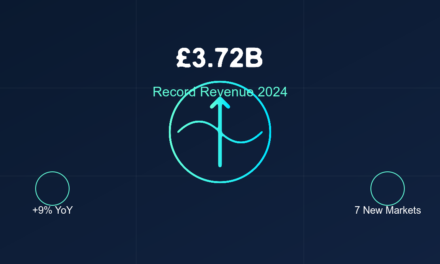

Playtech’s H1 2026 numbers make the B2B pivot look less like a corporate cleanup exercise and more like a working profit engine. Revenue rose 10%, while adjusted EBITDA jumped 77%—a gap that exposes where the group is finally finding high-value growth, and where its risks are becoming harder to hide.
America Is Producing the Margin, Not Merely the Growth
Playtech reported €425.1m in H1 2026 revenue, €162.5m in adjusted EBITDA, €95m in adjusted profit after tax and €101m in free cash flow. The headline is not simply that revenue increased 10%. It is that earnings expanded far faster than sales, indicating that incremental regulated-market revenue is carrying substantially better economics than the business mix Playtech has been shedding.
That is the commercial logic behind the group’s retreat from consumer-facing exposure. Snaitech and Caliente are gone or materially scaled back, removing businesses that could make a revenue line look fuller while leaving Playtech with a less coherent strategy. The remaining question was blunt: could the company’s platforms, content, compliance infrastructure, studios and account-management operation earn serious returns from major operators? H1 provides evidence that they can.
The mechanics are not mystical. A B2B supplier carries meaningful fixed costs in technology, regulatory capability, product development and service delivery. When a large regulated operator expands on that infrastructure, a larger portion of each extra euro can reach EBITDA. Better mix, fixed-cost absorption and more spending from premium accounts explain the 77% surge more convincingly than any presentation-deck slogan.
The consequence is a higher standard for management. Playtech has shown that regulated distribution can produce profit growth disproportionate to revenue growth. Investors now need to see whether that discipline survives expansion, rather than being dissolved in selective M&A that quietly becomes another acquisition spree with better branding.
Hard Rock Bet Drives the North American Upside – and the Dependence
US and Canada revenue rose 161% year on year, or 176% at constant currency. Hard Rock Bet in Florida was a central driver alongside Playtech’s wider regulated US iGaming footprint. Florida demonstrates the value of winning a deep relationship in a consequential regulated market instead of waiting for a neat national rollout that American politics has shown little interest in providing.
The US remains a patchwork of state rules, political resistance, tribal interests and operator-by-operator commercial conflict. That fragmentation can frustrate scale, but it also gives a supplier with the right operator access a valuable position inside a market others cannot simply enter by booking a conference room and issuing a press release.
There is an obvious catch. Hard Rock Bet is a growth engine, but it is also customer concentration wearing an expensive suit. A meaningful portion of the upside rests on a limited set of regulated relationships, led by one especially significant account. Commercial terms can change, product priorities can move and state expansion can stall. None of this reduces the quality of H1; it defines the durability test that follows it.
Playtech must turn a major-account success into a repeatable distribution model across several jurisdictions and operator partners. If it can, American exposure becomes a defensible earnings platform. If it cannot, the market will eventually translate the phrase “US exposure” into its less flattering but more accurate equivalent: dependency on a small number of customers.
Latin America Is Working Now; Brazil Remains a 2027 Execution Test
Underlying Latin America revenue increased 29%, led by Mexico and Colombia. That gives Playtech tangible regional momentum beyond the US and Canada in markets where regulated online gambling can expand quickly, yet where payment behaviour, local regulation and political risk make a standard European rollout a poor substitute for actual operating competence.
Mexico and Colombia are the live test cases for Playtech’s Americas strategy. They show the group is participating in regional growth rather than treating Latin America as a slide reserved for future-tense optimism. Brazil, however, is the much larger wager. Playtech expects to sign a strategic partnership deal by the end of 2026, with market entry targeted for 2027.
That timetable is disciplined only if management treats it as conditional. A partnership expected to be signed is not revenue, and a 2027 entry target is not a launch. Brazil has become the industry’s favourite empty box for projected growth, partly because it offers enormous promise and partly because an empty box cannot yet miss its quarterly numbers.
Playtech has a credible rationale for pursuing the market: a scaled B2B platform, regulated-market experience and Americas momentum. Execution will decide the outcome. The group must secure the right partner, integrate at speed, support local products and payments, and avoid committing capital before the economics are visible. That is where disciplined capital allocation stops being investor-relations furniture and becomes an operating requirement.
H2 Normalisation Is the Necessary Reality Check
Playtech expects FY2026 adjusted EBITDA to exceed €270m, while warning that H2 should normalise after an unusually strong H1 supported by one-off benefits and Americas momentum. Management deserves credit for putting the caveat on the table before analysts turn one exceptional half into a permanent growth rate.
With €162.5m in H1 adjusted EBITDA, guidance above €270m does not require the second half to reproduce the first-half pace. Anyone valuing Playtech on the assumption that 77% earnings growth is the new baseline is choosing excitement over evidence. The more useful question is whether the improved mix remains intact once temporary benefits fade.
A sharp slowdown without fresh regulated-market wins would reopen the central issue: how much of the surge reflected timing and one unusually lucrative customer relationship? CEO Mor Weizer’s stated formula—continued investment in growth areas, disciplined capital allocation and selective M&A rather than empire building—fits the B2B model now taking shape. It needs deeper regulated distribution, product quality and spending that earns defensible returns.
That puts pressure on Evolution, IGT and the broader supplier field. North American regulated iGaming can generate outsized supplier returns when operator access is right, which will intensify the contest for premium accounts and state-by-state relevance. Playtech has proof that its pivot is working; its next task is harder: make America’s exceptional half repeatable before rivals, regulation or customer concentration reclaim the margin.