
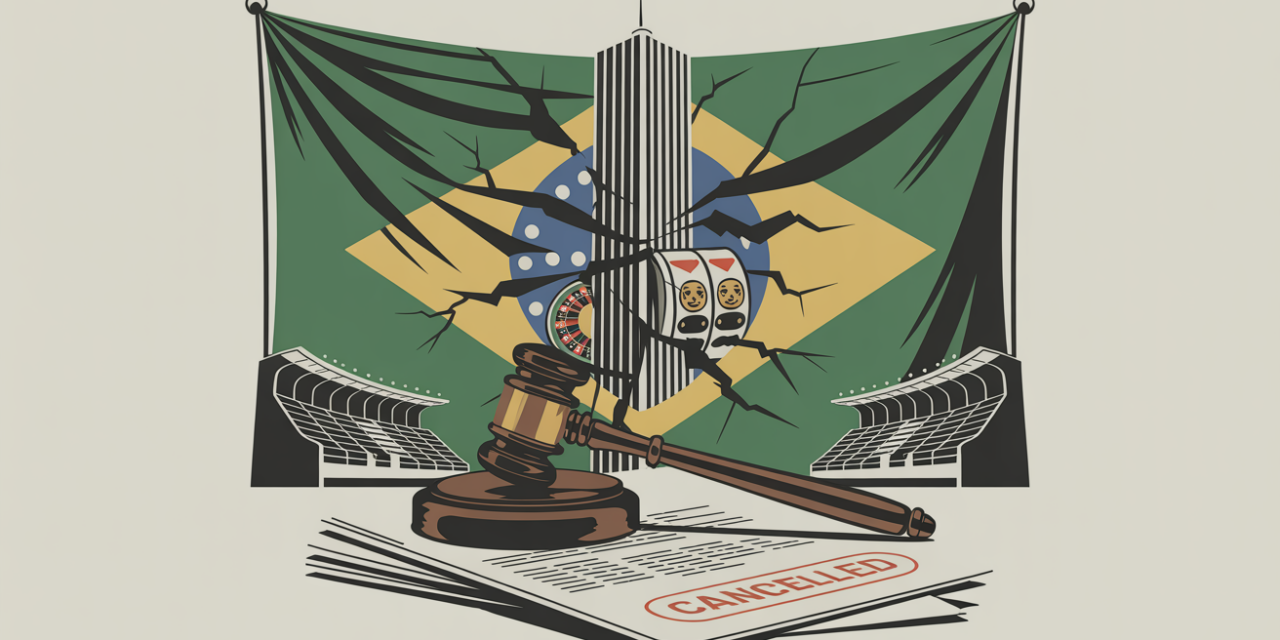
On January 1, 2025, Brazil switched on its regulated online gambling market. President Lula signed the Bets Law in December 2023. Operators spent time, money and significant compliance capital to obtain licences. A framework years in the making finally became operational.
Yesterday, Congress returned from its winter recess. The government’s stated priority: approve a bill to ban online casino games from the very market Lula created.
In the meantime, Rio de Janeiro and Belo Horizonte signed advertising ban decrees on July 13 with zero prior warning. Ten days to comply. Enforcement began the same day the decrees were published. São Paulo is next. New federal advertising rules took effect on July 17. A Supreme Federal Court case is now examining whether any of the municipal decrees were constitutionally valid in the first place.
This is not regulatory evolution. It is regulatory reversal happening simultaneously at federal, state and municipal levels, with different rules in different cities, no coordination between them, and no notice to the operators who built businesses on the framework that was supposed to govern the market.
What PL 2,258/2026 Actually Proposes
PL 2,258/2026 was introduced on May 7 by PT deputy Paulo Pimenta with explicit presidential backing. Its text is precise: Brazil’s regulated gambling framework will prohibit online casino games whose outcomes are generated by electronic systems or algorithms. Fixed-odds sports betting remains legal. Everything else — slots, crash games such as Fortune Tiger, table games, virtual casino products — is removed from the regulated market entirely.
The government has announced it will campaign for the bill’s approval before the first round of presidential elections on October 4, 2026. The electoral motivation is not subtle. Lula has repeatedly described himself as no friend of gambling and has argued that the current framework fails to protect vulnerable consumers or prevent financially distressed Brazilians from accumulating gambling-related debt.
A more extreme proposal runs in parallel. PL 1,808/2026, introduced in April, seeks to repeal the entire regulated betting framework, including sports betting. It has support from at least 68 lawmakers in the ruling party. It is not the government’s preferred vehicle. Its existence simply signals the political climate in which PL 2,258/2026 is being debated.
The bill still requires formal assignment by the Speaker of the Chamber of Deputies before it can advance. Even with presidential support, passage before October is not guaranteed. What is guaranteed is that the conversation is happening, that it is moving at speed, and that operators have no meaningful seat at the table.
The Advertising Layer: Decrees With No Warning
While the federal legislative debate continues, something more immediate has been unfolding at city level.
On July 13, Rio de Janeiro published Decree No. 58,274 and Belo Horizonte published Decree No. 19,654. Both signed the same day. Both effective immediately. Both ban betting advertising in public spaces, outdoor media, street furniture, municipal events and any space requiring a municipal licence or permit. Rio’s decree extends to company names, trademarks, websites, apps, bonuses, slogans, logos and mascots — anything that identifies a betting operator in a publicly visible space.
Operators received no prior warning. No consultation. No transition window beyond a 10-day compliance deadline, after which enforcement began. Rio’s mayor ordered the removal of existing advertising the day the decree was signed. São Paulo City Hall has promised to follow as soon as the measure clears its City Council.
This is the asymmetric deadline problem at its purest. Operators are expected to design compliance programmes, advertising strategies and commercial relationships inside a regulatory framework that can be materially altered overnight, with no notice, no consultation and no recognition that those businesses made investment decisions based on the rules as they stood.
The Constitutional Question Nobody Has Answered
Underneath the noise sits a legal question the Supreme Federal Court has not yet resolved: who actually holds the authority to regulate gambling advertising in Brazil?
The federal government introduced advertising rules effective July 17. States have enacted their own. Municipalities are issuing decrees. All of them are regulating the same operators in the same market under different — and sometimes conflicting — standards.
The Rio Grande do Sul state advertising law is currently challenged in ADI 7,971 at the STF. The Attorney General’s office has supported suspending it, arguing that the Constitution reserves advertising regulation to the federal level. If the STF agrees, every municipal and state-level advertising decree currently in force becomes legally questionable overnight.
Operators are therefore trapped between complying with municipal decrees that may be constitutionally invalid and ignoring them, which carries immediate enforcement risk. That is not a compliance challenge. It is a compliance impossibility.
The Sweden Comparison Operators Should Be Reading
Brazil’s stated justification for restricting online casino games is player protection. The assumption is that removing the product reduces harm. Evidence from markets that have tried similar approaches suggests the outcome is more complicated.
Sweden introduced strict bonus restrictions and deposit limits when it regulated in 2019. The result was a channelisation problem that Swedish regulators have been managing ever since, with a significant portion of players migrating to unlicensed offshore sites that continued to offer the products and promotions the regulated market had removed. Finland, preparing to launch its regulated market next July, is already incorporating Sweden’s channelisation failures into its own design.
Banning online casino games from Brazil’s regulated market does not make those games unavailable to Brazilian players. It makes them available exclusively through unlicensed platforms with no AML controls, no responsible gambling tools, no deposit protection and no regulatory recourse. The players Lula claims to protect will still access the products he wants to remove. They will simply access them somewhere he cannot reach.
The Tax Revenue Problem
Brazil’s federal tax agency has forecast R$13 billion in gambling tax revenue for 2026. Football leagues and media groups have become financially dependent on betting sponsorships. The Federal District Football Federation and the National Football Union have both published statements opposing the advertising bans already before Congress.
Removing online casino games eliminates a significant portion of the market generating that revenue. Restricting advertising accelerates channelisation back toward the unlicensed market, which pays no tax. The government is simultaneously trying to extract more revenue from the sector while reducing the sector’s ability to operate and communicate. Those two objectives are incompatible. The R$13 billion forecast makes the incompatibility visible in a way political rhetoric does not.
What This Means for Operators
The practical reality is straightforward. Operators active in Brazil need legal counsel tracking developments at federal, state and city level simultaneously, because the rules governing their advertising are currently different in Rio, Belo Horizonte and São Paulo and are changing independently in each. They need to monitor the STF case closely, because its outcome will determine whether the municipal decrees they are currently complying with were ever legally valid. And they need to stress-test their business models against the possibility that the casino vertical is removed from the regulated market before October.
That last point deserves to be stated without qualification. PL 2,258/2026 carries explicit presidential backing, a stated electoral timeline and a Congress that returned yesterday with it as a priority. It may not pass. The legislative process remains uncertain and opposition from football, media and the tax authority is real. But it may pass. Operators who are not planning for that scenario are not treating the risk seriously enough.
The Broader Lesson
Brazil’s regulated gambling market is nineteen months old. In that time it has generated billions in tax revenue, created thousands of jobs and produced a compliance infrastructure that licensed operators invested heavily to build.
The lesson is not unique to Brazil. Any market that regulates gambling is also a market in which the political will to restrict, reverse or dismantle that decision can surface quickly — particularly in an election year, and particularly when the social consequences of rapid market expansion become visible before the compliance systems designed to manage them have had time to function.
Operators who construct market-entry strategies around the assumption that a regulatory framework, once established, will remain stable are carrying a risk Brazil is currently making highly visible. Regulatory risk is not merely the risk of being penalised under existing rules. It is the risk of the rules themselves changing, abruptly, with no notice and no compensation for the capital deployed on the basis of the previous ones.
Brazil built a regulated market. Whether it keeps that market intact will be decided in the next sixty days.