
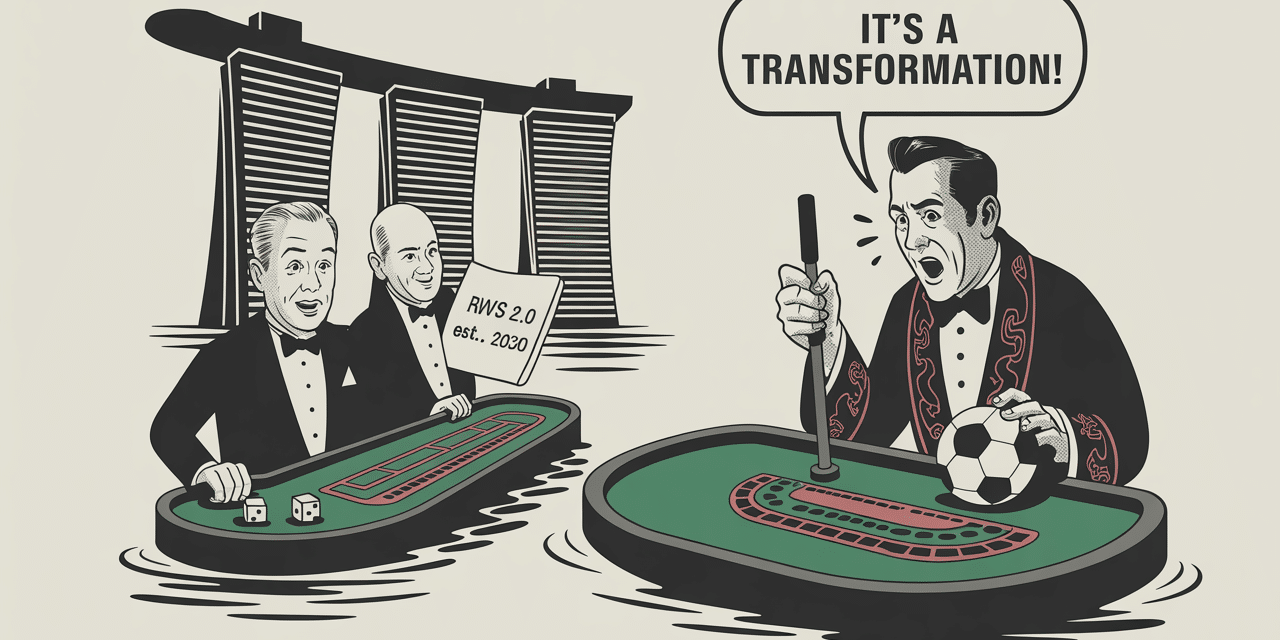
When a company’s net profit drops 55% in a single quarter and management calls the response a “long-term transformation,” that’s not strategy. That’s spin control with a PowerPoint deck. Genting Singapore just spent its 41st AGM explaining why Resorts World Sentosa is losing ground to Marina Bay Sands, and 4,000 miles away, Mario Ho is telling Macau it needs to start booking sportsbooks and esports arenas before the region gets left behind by digital-native competitors who couldn’t care less about VIP baccarat rooms. Both stories are the same story: Asia’s legacy integrated resorts built empires on a gaming model that’s aging out, and now they’re scrambling to figure out what comes next.
The RWS Reckoning: When “Tourism-Led” Means “We’re Losing the Gaming War”
Genting Singapore’s leadership spent its AGM doing what every management team does when the numbers are ugly: reframing the narrative. A 55% net profit decline in Q1 2026 isn’t a crisis, apparently — it’s a checkpoint on the road to the SG$6.8 billion RWS 2.0 program, due sometime in 2030. Investors were told to be patient. Tourism-led strategy. Financial discipline. Non-gaming attractions. All the language a company reaches for when it needs shareholders to believe the pain is temporary and the plan is sound.
Here’s the problem: Marina Bay Sands isn’t waiting around for RWS 2.0 to finish. MBS has spent the better part of a decade compounding its advantages — better location, sharper execution, a brand that reads “premium” while RWS increasingly reads “legacy.” Genting’s own management admitted the obvious during the AGM: declining gaming market share, operational headaches tied to Sentosa’s location, and a competitive gap that isn’t closing on its own. That’s a remarkable thing to say out loud at a shareholder meeting. It’s the corporate equivalent of admitting you’ve been out-hustled for years and are only now buying the gym membership to catch up.
The location issue deserves more scrutiny than it’s getting. Sentosa was a masterstroke decades ago — an island resort destination, insulated and controlled. Today it’s a bottleneck. Getting to RWS requires more friction than getting to MBS, and in a market where Singapore’s leisure travelers increasingly want convenience layered onto experience, friction is a quiet killer. No amount of non-gaming capex fixes a geography problem. Build the best attractions in Southeast Asia on Sentosa, and you’re still fighting an access disadvantage against a rival sitting practically on top of the Marina Bay skyline.
Mario Ho’s Sports-Plus Pitch: Macau Finally Admits It Has a Culture Problem
While Genting fights a geography and market-share battle in Singapore, Macau faces something more existential: a demographic and cultural mismatch. Mario Ho’s remarks at G2E Asia weren’t subtle. Macau’s gaming industry, built almost entirely around traditional casino play and VIP baccarat revenue, has no meaningful sports betting culture and barely any esports infrastructure. Younger players — the demographic every operator on earth is chasing — don’t want felt tables and junket rooms. They want live odds on football matches, esports tournaments, and entertainment that moves at the speed of a mobile notification.
Ho’s “sports-plus” framing carries weight because it’s coming from someone with actual skin in the game — he founded NIP Group and has real exposure to global esports economics. His pitch ties Macau’s ambitions directly to the 2026 FIFA World Cup, an event that will generate enormous global betting volume whether Macau participates or not. That’s the real threat buried in his comments: Macau can build the infrastructure to capture a slice of that demand, or watch international sportsbooks and offshore platforms hoover up the interest while Macau’s casino floors sit there offering nothing but baccarat to a shrinking, aging VIP base.
The brutal truth is that Macau’s entire regulatory and operational architecture wasn’t built for this pivot. Sports betting integration means new licensing frameworks, new compliance infrastructure, and — most politically fraught of all — a government in Beijing that has historically treated gambling expansion with extreme caution. Macau’s concessionaires can nod along with Ho’s vision at conference panels all they want, but building a sports-plus model requires regulatory movement that hasn’t shown any urgency to materialize.
The Systemic Pattern: Legacy Gaming Giants Are Getting Squeezed From Both Sides
Strip away the geographic specifics and both stories describe the same pressure. Asia-Pacific’s integrated resorts built their empires on a formula: massive capital investment, gaming-led revenue, VIP whale dependency, and non-gaming amenities as a supporting cast rather than the main event. That formula is cracking under two simultaneous forces — regional competitors executing better within the same model, and digital-native betting products stealing the demographic that legacy resorts need to survive long-term.
Genting’s problem is competitive execution within an old model. Macau’s problem is that the model itself is expiring. Both are existential on different time horizons. RWS 2.0 is a bet that Singapore’s tourism economy will reward whoever builds the better physical experience by 2030. Ho’s sports-plus vision is a bet that Macau’s economy needs an entirely new revenue category before younger players simply stop showing up.
What should worry operators across the region is how slow the response has been relative to how obvious the warning signs were. Digital betting habits didn’t emerge overnight. Younger demographics drifting away from traditional table games isn’t new intelligence — it’s been visible in Western markets for the better part of a decade. Asia’s land-based giants are only now, under financial duress, having the public conversation that should have started years ago.
Where This Goes From Here
Expect more of this candor at future earnings calls and industry conferences, because pretending the competitive gaps and cultural mismatches don’t exist stopped working the moment the numbers went public. Genting will keep pouring capital into RWS 2.0 and hoping tourism numbers outrun MBS’s momentum. Macau’s concessionaires will keep listening politely to sports-plus pitches while Beijing decides how much appetite it has for expanded betting categories. The winners in this next phase of Asia-Pacific gaming won’t be whoever has the biggest resort footprint. They’ll be whoever moves fastest from acknowledging the problem to actually restructuring around it — and right now, acknowledgment is the only thing anyone’s actually delivered.