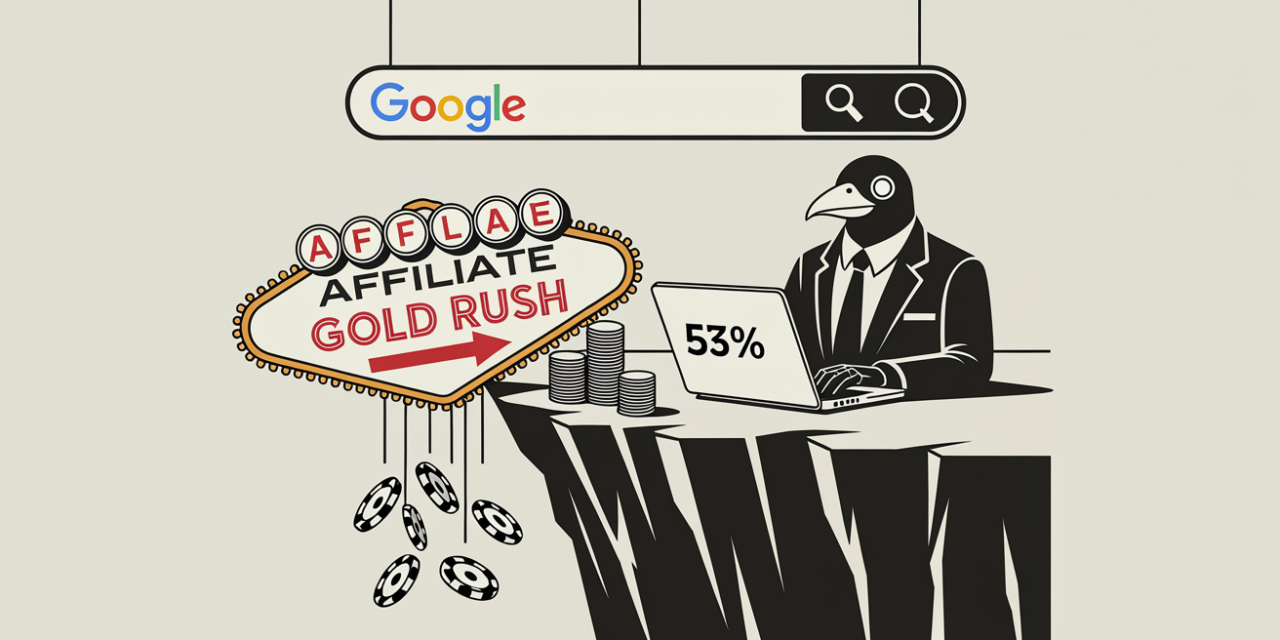
Gambling.com Group’s share price did not slide — it fell off a cliff. A 53% collapse in five trading days, a net loss, and a 25% workforce reduction dressed up as an AI pivot: this is what the end of an era looks like in real time.
The Numbers Don’t Lie — And Neither Does the Market
Strip away the corporate communications and Q1 2026 tells a brutal story. Revenue held at $40.4 million — steady enough to look respectable in a press release — but adjusted EBITDA cratered 43% year-on-year to just $9 million. The company booked a net loss. Analysts who had been extending goodwill to Gambling.com pulled price targets and downgraded ratings almost in unison. The market, which often gives iGaming growth stories a long leash, reacted with rare ferocity.
This is not a blip. When a publicly listed affiliate — one that built its identity as the premier content-led player acquisition engine in the US — loses more than half its market capitalisation in a week, the sector has to confront an uncomfortable truth: the affiliate-media model, as practised for the past decade, is under structural assault.
What Is Actually Breaking Here
The SEO arbitrage that built the affiliate sector’s economics is eroding faster than most operators or investors have been willing to admit. Content-led affiliates built their businesses on a simple formula: produce high volumes of optimised content, rank prominently in Google, funnel players to operators, collect revenue share or CPA commissions, repeat. Asset-light, scalable, and — when search was predictable — highly profitable.
Google’s algorithm shifts over the past 18 months have dismantled that predictability. Helpful Content Updates and the aggressive rollout of AI-generated search summaries have fundamentally changed how gambling-related queries surface and resolve. Players who once clicked through to affiliate review pages are increasingly getting answers — or what Google decides are answers — before they ever reach an affiliate’s content. Organic search traffic for informational gambling queries is declining across the board, and with it, the conversion funnels affiliates spent years perfecting.
Gambling.com’s Q1 results explicitly cited weaker search performance as a primary driver of the EBITDA collapse. This is not a company-specific failing. This is a sector-wide vulnerability that Gambling.com has simply been forced to expose first, at scale, in public.
The AI Pivot: Genuine Strategy or Narrative Management?
Cutting 25% of your workforce while announcing an AI-first restructuring is a move that deserves serious scrutiny. The company projects $13 million in annual cost savings — which, set against a $9 million EBITDA quarter, tells you everything about how thin the margin stack has become.
The pitch is that AI-generated content and automated workflows will replace the human content operations being eliminated. The CEO has framed this as proactive evolution toward operational efficiency. Here is the contradiction nobody in the press release wanted to address directly: if AI-generated content is the solution, it is also a significant part of the problem. Google’s algorithm updates have specifically targeted thin and AI-generated content. The affiliates suffering most are those whose content factories have already been flagged by search quality systems. Doubling down on AI content production in response to an AI-content penalty is a strategy that requires considerably more explanation than it has received. The PR framing is clean. The logic is not.
The $13 million in projected savings sounds meaningful until you examine the revenue trajectory. Full-year guidance was revised downward to between $165 million and $170 million. If search performance continues to weaken — and there is no structural reason to assume a quick recovery — those savings will be swallowed by continued top-line pressure.
The Catena Contrast: Bifurcation Is Already Happening
For every argument that the affiliate sector faces an existential reckoning, Catena Media offers an inconvenient counter-data point. Catena returned to profit in Q1 2026, posting revenue growth of 26%. That is not a footnote — that is a fundamentally different operational outcome from a company operating in the same macro environment.
The difference reframes the conversation entirely. This is not a sector-wide death sentence. It is a split between affiliates who have successfully adapted their player acquisition models, content strategies, and operator relationships — and those who have not. Catena’s recovery suggests that affiliates with tighter geographic focus, diversified traffic sources, and less dependence on high-volume informational SEO can still generate meaningful returns.
For operators, this split should prompt an immediate audit of affiliate channel dependency. Which partners in your acquisition mix are structurally exposed to the same pressures hitting Gambling.com? How concentrated is your new player volume in content-led affiliates whose traffic is primarily Google-dependent? These are not hypothetical questions anymore. They are balance sheet questions.
What Operators and Investors Must Do Now
The operator community has long treated the affiliate channel as a cost-efficient, performance-based free lunch: you only pay when players convert, acquisition risk sits with the affiliate, the relationship scales with market growth. That comfort has bred complacency about the underlying fragility of the model.
Operators heavily reliant on content affiliates for player acquisition need to stress-test that dependency immediately. The channel is not disappearing — but the economics are shifting, reliable traffic sources are becoming unreliable, and the affiliates who survive this correction will likely command different terms because of their scarcity value. Operators who have not already built meaningful direct acquisition capability are exposed.
For iGaming investors, the Gambling.com collapse is a stress test that should trigger a re-evaluation of how affiliate businesses are valued. The asset-light model was always predicated on the assumption that organic search traffic was a durable, defensible asset. It is not. Traffic is a rented asset, and Google just changed the lease terms without notice.
Search algorithm dependence should now be treated as a risk factor with the same seriousness as regulatory exposure or market concentration. Affiliates with diversified traffic — brand, direct, paid, social, data-driven — deserve a different valuation multiple than those generating 80% of revenue from Google organic. Any investment thesis that ignores this distinction is working from an outdated model.
Fewer Players, Higher Stakes
The affiliate sector will not collapse. But it will consolidate sharply, and the survivors will look very different from the content factories that defined the previous decade. AI automation will play a role — but not in the crude, fire-the-writers-and-generate-everything sense that Gambling.com’s restructuring currently implies. The affiliates who endure will use AI to sharpen editorial quality, accelerate data analysis, and improve personalisation — not simply to cut headcount and hope Google looks the other way.
The US market, which Gambling.com had positioned as its primary growth engine, adds further pressure. Regulated state-by-state iGaming and sports betting markets are maturing, competition for player acquisition is intensifying, and operators are investing heavily in their own direct-to-consumer capabilities. Every dollar an operator puts into its own SEO, CRM, and brand marketing is a dollar that bypasses the affiliate channel entirely.
Gambling.com’s crash is not just one company’s crisis. It is the clearest signal yet that iGaming affiliate media’s golden decade is over — and the reconfiguration of who controls player acquisition, and at what cost, has already begun.