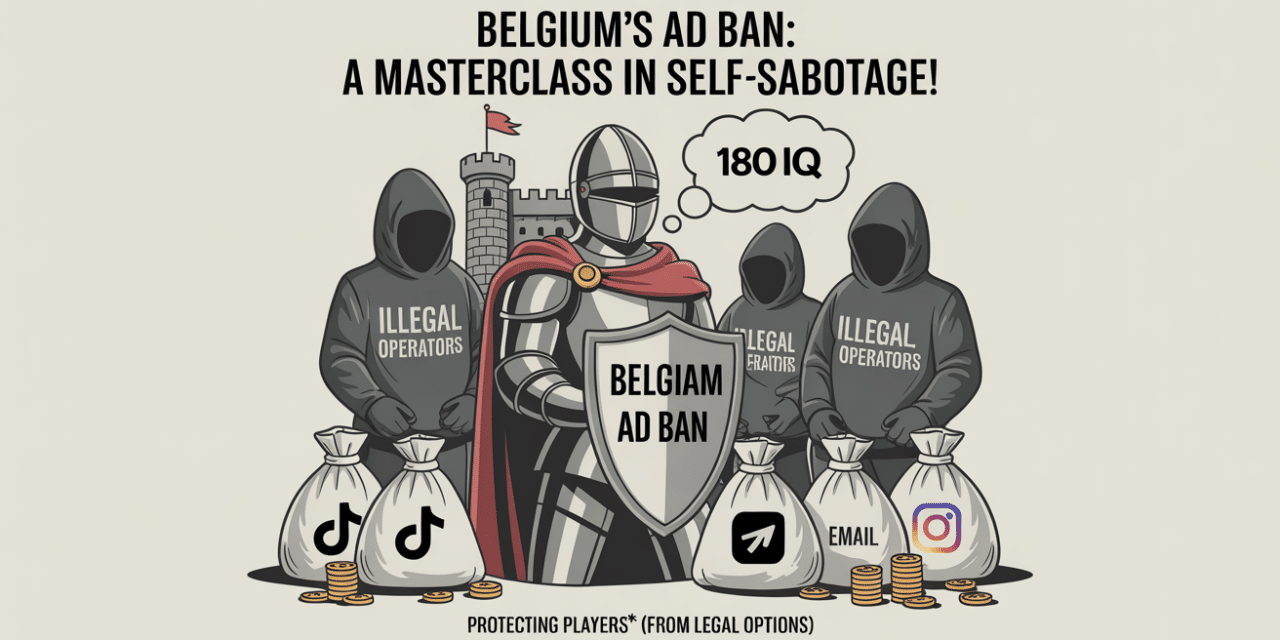
The Belgian government’s crusade against gambling advertising is a case study in unintended consequences. By attempting to « protect » players through a blunt-force media ban, regulators haven’t extinguished the fire—they’ve simply handed the matches to criminals.
Massimo Menegalli, CEO of Golden Palace, recently took to LinkedIn to voice what anyone with a basic understanding of market dynamics already knew: the « black market » is the only sector currently popping champagne.
The « Hide-and-Seek » Paradigm: Why Bans Fail
The Belgian regulatory framework, which purged gambling from TV, radio, and billboards in 2023, followed by a sports sponsorship ban, was built on a superficial premise. The logic? Out of sight, out of mind. The reality? Asymmetric warfare.
-
Regulated Operators: Shackled by compliance, forced into the shadows, and stripped of their ability to signal « trust » to the consumer.
-
Illegal Operators: Flooding TikTok, Telegram, and Instagram with zero friction, zero taxes, and zero player protection tools.
Menegalli accurately describes this as an « absurd game of hide-and-seek. » When you remove the lighthouse (legal brands), the ships (players) don’t stop sailing; they just crash into the rocks (unregulated sites).
The Italian, Spanish and UK Precedent
Belgium is repeating the exact failures of Italy’s Decreto Dignità and Spain’s restrictive advertising laws. Historically, these bans do not reduce the GGR (Gross Gaming Revenue) of a nation; they simply redistribute it from tax-paying, audited entities to offshore ghosts.
The Survival Pivot
Legal brands are now forced into « workaround » survivalism. As Menegalli noted, disappearing completely is a « death sentence. » This creates a fragmented market where:
-
Brand equity is eroded.
-
The cost of acquisition (CPA) sky-rockets for legal entities.
-
The distinction between a safe, licensed site and a predatory « black market » site becomes invisible to the average punter.
From Moral Posturing to Algorithmic Reality
The core of the issue—and where the Belgian regulator has shown a staggering lack of intellectual depth—is the nature of modern communication.
« The real question is no longer whether to ban gambling advertising, but how can we regulate de-territorialised, fragmented, algorithmic communication? » — Massimo Menegalli, CEO Golden Palace
The Systemic Failure
Regulators are using 20th-century tools (linear media bans) to fight a 21st-century war (algorithmic targeting).
-
Cause: A desire for « visible » political action.
-
Effect: A complete loss of digital sovereignty.
By banning legal ads, the government has effectively abandoned the digital field. They have no jurisdiction over a Telegram bot or a Curacao-licensed site targeting Belgian IPs via influencer marketing.
A Gift to the Shadow Economy
Belgium’s policy isn’t « protection »; it’s market abdication. Until regulators move past the « ban » reflex and start addressing how to maintain the « channelization » of players toward safe environments, the illegal market will continue to feast on the remains of the regulated industry.
The « flood defense » hasn’t just failed—it was never built to withstand the tide of the internet.
Disclaimer: This article and its accompanying images may have been enhanced using AI tools to ensure smoother content delivery and visual appeal.