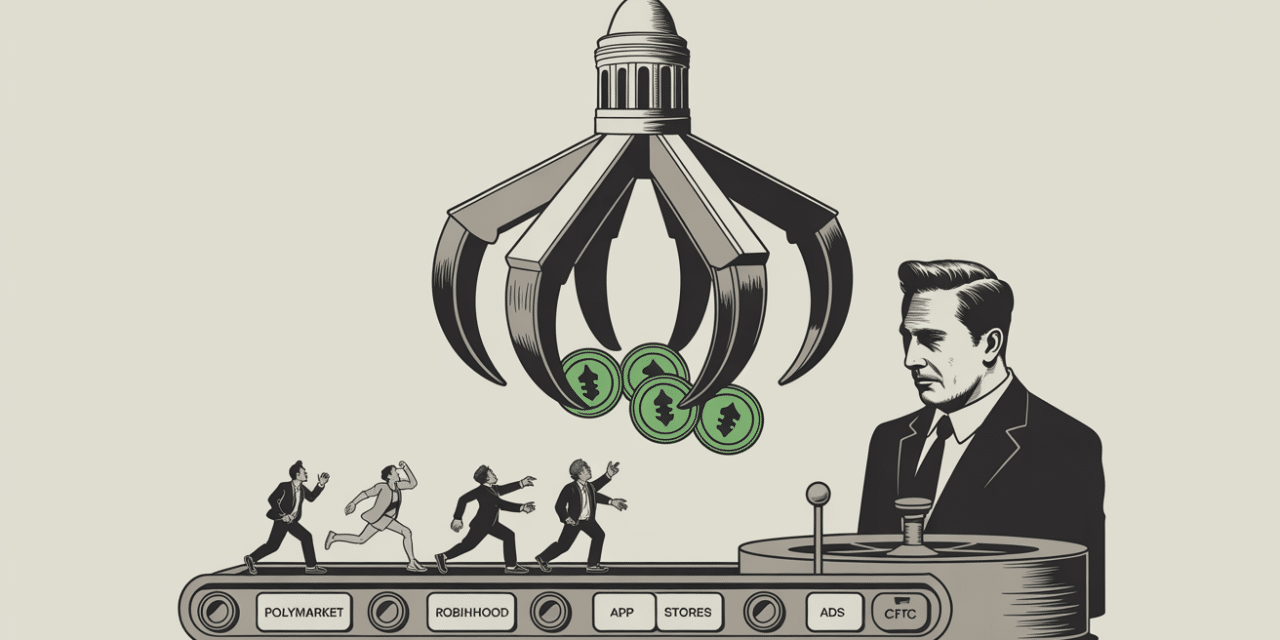
Connecticut did not send prediction-market operators a polite licensing reminder on Sept. 10, 2026. Its cease-and-desist campaign treats sports-event contracts as alleged illegal gambling and targets not only the firms selling them, but the digital infrastructure that makes them work. That distinction is the whole story. The state is not arguing over a label in isolation; it is challenging an operating model built around the proposition that a product can look, feel and be sold like a sports wager while wearing a financial-services badge.
Connecticut Is Targeting the Plumbing
The Connecticut Department of Consumer Protection ordered nine businesses to stop advertising, offering or making available sports-event contracts and other alleged unlicensed online gambling to Connecticut residents. The targets are Polymarket, Coinbase, Crypto.com, Robinhood and Robinhood Derivatives, ProphetX, Novig, Webull, Gemini and Underdog Predict. The orders require customers to be allowed to withdraw money already held, while warning of civil penalties under the Connecticut Unfair Trade Practices Act and possible criminal penalties under state gaming statutes.
The more consequential move is the subpoena campaign aimed at roughly 30 third parties. Payment processors including PayPal, Stripe and Plaid, app stores, sports-data suppliers, identity-verification providers and media outlets carrying prediction-market advertising are all part of the inquiry. Connecticut understands that an online gambling product needs deposits, verification, market data, distribution, advertising and a way to pay winners. Cut enough of those links and a polished trading interface becomes a very expensive empty webpage.
The downstream pressure is potentially larger than the orders themselves. A vendor does not need to agree with Connecticut’s legal theory to decide that records requests, compliance reviews and possible association with alleged illegal gambling are not worth the revenue. App stores and payment firms have plenty of reasons to avoid becoming test cases. Media outlets can decide that advertising inventory is less valuable once a regulator wants to know who bought it and how it was presented. Connecticut does not need every supplier to leave at once. It only needs enough friction to make expansion slower, more expensive and less certain.
The Financial-Product Defence Faces a Reality Check
Prediction-market operators argue that sports contracts are federally regulated event contracts, not sports wagers. Robinhood advanced that defence after Connecticut acted, saying its contracts are offered through a Commodity Futures Trading Commission-registered entity and are subject to federal oversight. It is a tidy legal position, but it looks less tidy when customers can take positions on whether a team wins a game and see the product marketed beside betting apps to the same sports audience. The customer is not being asked to admire the architecture of commodities law.
The key claim is that CFTC registration pre-empts state gambling law. If courts accept it, firms could offer sports-event contracts nationwide without state gaming licences, sportsbook taxes, responsible-gambling mandates, geolocation rules or bookmaker-specific integrity requirements. That is why this is bigger than a dispute over terminology. Licensed sportsbooks have spent years winning state-by-state approval, while prediction markets insist they are fundamentally different despite selling an experience that can look remarkably similar from the customer’s chair. The commercial prize is obvious: sports-betting economics without the state-level obligations that accompany sports betting.
This is where the arbitrage becomes hard to ignore. States regulate sports betting around problem gambling, integrity, underage access and market-conduct risks. Prediction-market firms want the argument to begin and end with federal product classification. Connecticut is asking whether classification should erase the risks that caused states to build those rules in the first place. If the answer is yes, licensed bookmakers lose ground to competitors that avoid their costs. If the answer is no, the financial-product defence becomes less a shield than a premium-grade branding exercise with a very expensive court bill attached.
Conflicting Courts Are Building a National Mess
Connecticut is entering a fight already playing out in roughly 19 states, with incompatible rulings giving both sides ammunition. On Aug. 28, the Ninth Circuit ruled that Nevada can apply its gambling laws to sports-event contracts and that the contracts are not protected swaps. Kalshi sought en banc review, while Robinhood filed a Supreme Court cert petition on Sept. 9. In Iowa, U.S. District Judge Stephen Locher denied Kalshi’s preliminary-injunction request on Sept. 8, finding the company was unlikely to show that the Commodity Exchange Act expressly pre-empts Iowa’s gambling laws.
The record is not entirely hostile to the industry. New Jersey filed a Supreme Court petition on Sept. 2 after the Third Circuit ruled for Kalshi, creating the split operators need to keep their model alive. Legal disagreement is not merely a courtroom curiosity here. It gives companies room to continue arguing that their approach is viable, gives investors a reason to frame uncertainty as opportunity, and gives customers a product before the rules are settled. In a business built on acquiring habits early, delay can be valuable.
Meanwhile, under a court-approved stipulation signed Sept. 4, Robinhood stopped offering new sports-related contracts to Michigan customers by Sept. 9 and must close remaining positions by Oct. 9. The Tenth Circuit declined Kalshi’s emergency request to block Utah enforcement, and British Columbia’s Independent Gambling Control Office has said sports and entertainment prediction markets are gambling rather than securities or derivatives. The fragmented result is a national mess: customers receive different choices depending on location, companies face different exposure by jurisdiction, and states are left enforcing their own rules while waiting to learn whether those rules can ultimately survive.
Supplier Pressure Raises the Cost of Defiance
Traditional gambling enforcement goes after the operator because it is the easiest logo to find. Connecticut’s approach is more precise: it treats digital gambling as a chain of commercial dependencies. Its subpoenas tell vendors that they are not invisible simply because they do not set odds or settle contracts. A data provider serving both sportsbooks and prediction markets may decide the exposure is not worth it. Payment platforms can tighten merchant monitoring, app stores can demand more documentation, and publishers can reprice or reject ads.
That friction matters because it hits customer acquisition and operations at the same time. It also redistributes power toward the firms already able to absorb legal uncertainty and compliance demands, while smaller operators and suppliers face the sharper choice between risk and retreat. Underdog’s federal lawsuit against Connecticut ensures the fight will not remain administrative. By Sept. 15, Polymarket, Coinbase, Crypto.com, Robinhood and Underdog Predict had not publicly responded to the orders, apart from Robinhood’s federal-regulation defence. Silence may be prudent lawyering, but it does not answer whether sports-betting safeguards are optional whenever the product is packaged differently.
The Supreme Court is increasingly positioned as the real regulator. A ruling against pre-emption would force state-by-state compliance, withdrawal of sports contracts, or a grim test of how long vendors tolerate the risk. A ruling for it could create a federally regulated sports-wagering channel outside state licensing systems. Until then, states have every incentive to copy Connecticut’s tactic: do not wait while operators build customer habits, vendor dependencies and political influence. Attack the rails, raise the cost of defiance and make the financial-product label carry the weight the industry has piled onto it. For prediction markets, this is not a routine compliance headache. It is an existential audit still gathering documents.